

True Detective (Season 3) – Nic Pizzolatto (HBO)
The set up in this season was brilliantly designed. The conclusion, I think was less so. I think I enjoyed the week-to-week speculation about it more than the series itself. Which is not to say that the series wasn’t enjoyable. Mahershala Ali and Stephen Dorff were incredible. The series used a three timeline structure surprisingly well. My overall issue is that I think the questions and mystery proved more interesting than the answer. Pizzolatto is interested in a dynamic between isolated life and broader conspiracy. The allusions to other crimes, other towns, and other seasons of the show aren’t an accident. The conclusion of this season is that this particular crime was an isolated incident, a series of accidents. I hope this means that Pizzolatto is waiting for a future season to connect these crimes and actually dive into the larger conspiracy he keeps hinting at. My fear is that he’s more interested in making a commentary on the nature of true crime and theorizing. If that’s the case, I think it’s pretty dicey. He’s clearly using those tropes to drive his show on. To then say, “Wait a sec, this isn’t right” seems pretty weak sauce to me. Regardless, I’m still probably on board for Season 4.
Grade: B- / B
My Brilliant Friend – Saverio Costanzo (HBO)
I found this miniseries to be surprisingly compelling. To be clear, I love the novel and series the show is based on. My concern with this adaption is that those novels are so interior. Their defining characteristic is how the protagonist relates her world to the reader. Adaptations are risky for a million reasons. I thought the stakes of this show would be even riskier. Its first conceit would be relating the world for us. It mostly works. The show is beautifully shot, the actors are both fantastic and well-cast to the characters. The show is rigidly faithful to the book, and the pacing works well. My few knocks are pretty basic. There’s nothing mind-blowing about the show. Nothing incredibly compelling that makes you have to watch more. Instead, it’s a pretty good show, made exceptionally well. That works on its own. Compared to the novel it falls short.
Grade: B-
Veep (Season 7)- David Mandel (HBO)
Veep has to be one of the most consistent shows of all time. Its final season was no exception. It is so brutally funny. Like most shows, its later seasons became more and more a product of itself. Thus, Season 7 was the most outrageous. The characters were the worst possible versions of themselves. I think it worked beautifully. Two decisions they made really stood out to me. First, I loved that they doubled down and just paralleled our current political situation. I think it’s a decision that wouldn’t work in many other shows. Here, I think the world of the show is actually more outrageous, so it feels almost natural. Second, I loved that they had so many great actors and comedians come and do bit parts. It’s such a flex but it totally worked. I don’t think this was a top two or three season for the show, but that would be such an impossibly high bar. I just felt grateful that the season was back and that it was still good.
Grade: B / B+
Trigger Warning – Killer Mike (Netflix)
This series was so surprising, spectacular, and enlightening. I still don’t know if I’ve fully comprehended it. I love Killer Mike and Run the Jewels and still had no expectation that the show would be this good. It’s a wonderful and common premise. Mike takes a look at something that isn’t right and explains it. It’s the same set up as almost any talk show. What sets this show miles apart is that Mike not only offers a solution but goes and enacts it. And these solutions are mostly batshit crazy. But there’s some wisdom and truth in all of them. I feel like he is doing what postmodernist authors try to do. A couple of the episodes aren’t as good as the others, but overall this series was incredible. I hope there’s more.
Grade: A
Pen15 – Maya Erskine, Anna Konkle, Sam Zvibleman (Hulu)
This show hinges upon a unique and pretty daring structural conceit. The two main characters are adults playing middle schoolers. It’s brilliant. Yet, for as radical as this twist is, in almost every other way this show feels pretty old school. Which is not to knock anything about the themes the show is exploring, or how vulnerable the show makes its characters and by extension the audience. In fact, I think it’s this conceit that really opens up the show’s ability to explore these themes. It’s old school in the best way possible. It’s almost a straight sitcom: the situation is middle school, comedy ensues. I love sitcoms and this is the best one I’ve seen in a long, long time. I really found this show to be viscerally funny.
Grade: B+ / A-
Killing Eve (Season 1* & 2) – Phoebe Waller-Bridge, Emerald Fennell (BBC America)
An exceptionally well-done thriller. The two stars are incredible and more than carry the show. Jodie Comer is a delight to watch. Villanelle is such a funny, compelling villain. I would watch a whole show with just her and no real stakes. What sets the show apart is Sandra Oh’s ability to play off of her. It’s so nuanced and subtle. Here, I will acknowledge that the plot is outrageous, contrived, unbelievable, etc. I don’t think it matters. The show is so true to its characters that I’m okay to work with these faults.
Grade: A-
*Aired 2018
Game of Thrones (Season 8) – David Benioff, D.B Weiss (HBO)
An unmitigated disaster. I acknowledged before the season that pulling off this final season would be a near-impossible feat. I expected that the plane would crash into the runway. I did not anticipate it’d burst into flames over the ocean. I am torn because I love Game of Thrones. I have loved it, even simply, as a TV show. Even to the end, I couldn’t wait for each episode. I thought the second episode, “A Knight of the Seven Kingdoms” was one of the show’s finest moments. On the other hand, it’s really inconceivable to me how the show could have ended this poorly. Making good television is an extraordinary feat. It’s really hard. That’s why there isn’t very much of it. But it is shocking to me how something as beloved, and elaborately produced as Thrones, would be capable of ending this badly.
Grade: D
Tuca & Bertie – Lisa Hanawalt (Netflix)
The most pleasant, delightful show I’ve watched all year. The animation is wonderful. The characters are vibrant. Everything about the show is so full of enthusiasm and life. It’s infectious. And that’s not to say this show doesn’t have real weight to it. Almost all of the episodes tackle a pressing issue. It will undoubtedly be compared to Bojack Horseman because of its creator and the animation. But I think the real comparison lies in its ability to pull off the balance between absurdity and real issues in a way that few shows besides Bojack have done. And in fact, I think I like the tone of Tuca & Bertie a bit more. I’m glad it’s a just a little lighter than Bojack. It’s one of the things I feel like is a big improvement. More on that next…
Grade: B+
BoJack Horseman (Season 5) – Raphael Bob-Waksberg (Netflix)*
BoJack has such a strange trajectory to it. I remember in the first season telling my cousin AJ that he should check out the show because it had crazy anthropomorphic animals and lots of puns. The show still has that in Season 5 but has so much more heaviness to it. In this season, the show explores issues of mental illness, substance abuse, misogyny, and depression more thoroughly than any other show I can remember. I think, for the most part, these explorations are worthwhile and enlightening. But while I really appreciate that aspect, I couldn’t help but feel a bit bogged down by it. You couldn’t help but feel suffocated by how dark and depressing the show has become. That’s not necessarily a bad thing. Still, I found myself not having the urgency to come back for each episode because of it.
Grade: B-
*Aired in 2018
I Think You Should Leave – Tim Robinson (Netflix)
Easily my favorite thing I have watched all year. This show is so fucking funny. As someone who doesn’t watch improv or sketch comedy, here is my understanding of it. Each sketch starts out with a setup or premise and then presents a complication. Literally joke-telling 101. And here, you think a lot of the genius is just in these outlandish premises. They’re so weird it really could be. This is what I think the idea is behind most SNL sketches. And in this show, it’s the idea of a Baby of the Year competition or someone taking a bumper sticker too seriously. But the true genius of this show is that the sketches all take another turn. In most cases, the punchline or resolution is a complete twist. The bystander who is reacting to the bizarre setup has, in fact, gone along with it. The joke is back on the other person. Take the focus group sketch. It’s a normal group of people with one very old, bizarre, Italian man who keeps offering up the worst ideas. So you think the joke is just that there’s this insane person in an otherwise normal situation. But as he starts making fun of one of the other participants, you realize that everybody else in the room is on board with him. They’re playing by his rules. The joke is not on him but on the “normal man”. I have watched the entire show three times and these sketches still keep getting funnier and funnier. It takes a minute to calibrate to Robinson’s style, but once you do, it’s incredible.
Grade: A
Fleabag (Seasons 1* & 2) – Phoebe Waller-Bridge (Amazon)
Let’s get this out of the way. The first season of the show is overrated. Which is to say I liked it. But I did not understand where all of the hype was coming from. It’s a really well-written, dark show that tackles heavy subjects: substance abuse, self-abuse, grief. But I didn’t love the conceit of her breaking the fourth wall. I found Fleabag and the people around her to be a little too terrible for me to grapple with. The first season was a solid B for me. A good show, but not my favorite.
The second season is amazing. I don’t know how she recalibrated it, but every decision is brilliant. Again, I did not like her asides to the camera in Season 1. In Season 2, I couldn’t get enough of them. I couldn’t get on board with the characters in Season 1. In Season 2, I found their individual struggles to be heartbreaking. Moreover, everything about the show was scaled up. It’s evident right away in which the entire first episode takes place at a dinner party. Fleabag is a show that I don’t have much connection to. I’m not on the same wavelength. It’s not always hitting me right in my soul. Yet, it is undeniably brilliant. Every aspect of its storytelling and filmmaking is an 11/10. I’m so glad I stuck with it.
*Aired 2016
Grade: A- / A
Deadwood (Season 1*) – David Milch (HBO)
With all of the hype around the Deadwood film, I decided to finally dive into the show. For me, I’d put the first season right below the prestige TV heavyweights (Mad Men, Breaking Bad, Sopranos, etc.). So what’s brilliant about it? The tone of the show lives up to the hype. Ian McShane’s brutal, profanity-laced, tirades are incredible. You’re sucked into the world of Deadwood. You’re calibrated for the rules (or lack thereof) of the town and of the show. The beginning of the series is a thrill. I loved the decision to kill Wild Bill Hickock. It’s a stunning moment. And one that I didn’t see coming given that this show aired in 2004. I do think the plot loses a little steam after his death. I’m interested to see if they can refocus it in Season 2.
So what is it that holds the show back for me? I think the characters aren’t as fully realized as I would like them to be. Or perhaps, not compelling enough. This show reminds me in a lot of ways of Mad Men. It’s a huge ensemble, each with various roles, that all revolve around this one place. In Mad Men, it’s Sterling-Cooper. In Deadwood, it’s the town. But the best part of Mad Men is the characters. I would have kept watching if there were no plot. In Deadwood, there are many brilliant performances, but fewer dynamic characters. For as masterful as Ian McShane is, Al Swearengen is kind of a one-note person. Seth Bullock, to take it further, is almost the literal definition of a one-note character. There are some exceptions. I love the doc and think that the widow is fully developed too. But it’s a weakness in an otherwise pretty exceptional show.
Grade: B / B+
* Aired 2004
Chernobyl – Craig Mazin (HBO)
The best show I’ve seen in some time. Chernobyl is every accolade you could laud a show with. It’s fully-realized, perfectly pitched, poignant, devastating, sensitive, intriguing, and respectful. I think every decision that Mazin makes is the right one. It’s an incredible accomplishment. Especially given that this is a recent historical event. He is so respectful to all involved in the disaster without pulling any punches about the negligence that led us here. I thought the dynamic between the Soviet Union and the United States was really interesting. While the show acknowledges that this event happened in, and in large part because of, the Soviet Union, it also makes a compelling case that the heroics needed to stop it were only possible there too. I loved how Mazin doled out enough information for the viewer to understand the stakes in each episode but held on to the full truth of what had happened until the end. It was a lasting and powerful message. Last year, my favorite film was First Reformed in large part because it felt like the most relevant film I had seen. It spoke so clearly to the anxieties of being alive in the 21st century that it made other films feel non-essential. That’s what Chernobyl feels like compared to other television. Yes, it’s a show documenting a 25-year-old historical event. But it’s also a show about truth and lies, the responsibilities of the state, man vs nature, the danger belied in the promise of technology. There was no show more relevant this year and Mazin made sure that every punch this show had would hit at full force.
Grade: A
Barry (Season 2) – Bill Hader, Alec Berg (HBO)
Barry is no longer a comedy. Thankfully, it is still great. While most of the show worked for me, I realize I am more compelled by the actual filmmaking than the story. I enjoyed following Barry and Sally’s struggles to progress as actors. Henry Winkler is still a delight. Noho Hank is the funniest villain on television. But what I really loved about the show was everything leading in and out of “Ronny/Lily,” the best episode of T.V. this year. Loach’s reveal that he wanted Barry to kill Ronny was perfectly set up. Each development in the episode was stunningly funny. It was a perfect 30-minute horror movie. So while there were no real disappointments in the season, I couldn’t feel like it was all a bit overshadowed by a perfect episode. Definitely not the worst problem to have.
Grade: B+
Stranger Things (Season 3) – The Duffer Brothers (Netflix)
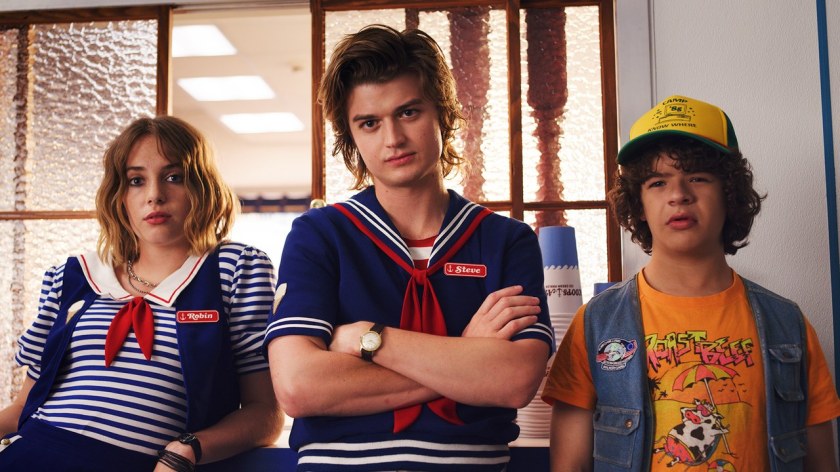
The third season is a return to form in every single way. And in some cases, an improvement even on Season 1. The best decision, by far, is to split the kids up. The season consisted of multiple storylines. Miraculously, each of them was pretty compelling. So while part of me (all of me) would be down for an entire show of just Steve, Dustin, and Robin, I was never disappointed to be hanging out with Janice and Hopper, the other kids, or Nancy and Jonathan. Likewise, I loved the decision to make the entire season essentially all one day. While I’m not always sold that’s a good thing, here there were so many characters and storylines, I’m glad that time wasn’t a factor. More than that, I loved that they got each character into the best possible wardrobe and kept them in it. Were there faults in the season? It depends on how closely you want to read the show. The sci-fi/fantasy elements are, at best, loosely defined. Will’s character existed this season just to warn people about the Mind Flayer or react to those around him. Hopper and Janice’s character turns don’t really hold up to scrutiny. Yet, I think with the way I watch the show, these are all strengths. The surface level sci-fi is enough for me. It keeps the plot and characters moving which is really what I care about. Will didn’t get to be a kid this season, but his reaction to that was pretty moving. Hopper and Janice both acted outside their usual arcs, but it was a welcome change. This season was so big and ambitious that there were plenty of holes. There’s just no way you could make a story this big and told so compactly that there wouldn’t be. For me, I’m glad they’re there. Stranger Things is meant to be a fun binge watch. This season was the best version of that.
Grade: A-
The Knick (Season 1*) – Steven Soderbergh (Cinemax)
Though I had only heard great things, I wasn’t sure what to expect in a television show from Steven Soderbergh. While it’s pretty common for a feature filmmaker to produce a show, it’s usually just to direct the pilot and establish the visual language. After that, the show is typically left to the writers to create the rest of the series in the image of the pilot. That was the case, for example, with Martin Scorsese in Boardwalk Empire or David Fincher in House of Cards. I suppose the other model for a filmmaker doing television is to make a show that is essentially just a really long movie. This would be something closer to Stranger Things.
Soderbergh doesn’t follow either of these paths. First and foremost, he directs every episode. And in a series that works on almost every level, his direction is the standout feature. The shots are all handhelds. For a show that is both a period piece and about very technical information, that decision provides a lot of dynamism. The shaky camera makes the setting and characters come alive. It heightens the tension and terror of the surgeries. The second big deviation is that while The Knick is incredibly cinematic, it is still television. The storytelling is episodic. It takes its time to explore the characters. It’s centered at one location, The Knick. I thought it was incredibly refreshing to watch a high-level television show that didn’t feel like it was barreling toward an endpoint. In the aftermath of Mad Men and Breaking Bad, it feels like too many shows are focused on their endings at the cost of their individual episodes. In fact, my only complaint with The Knick is with the last episode. It felt like such a deviation because of the attention it pays to setting up the next season. Hopefully, that’ll be a small price for Season 2 staying as brilliant as Season 1.
Grade: A
*Aired 2014
Broad City (Season 5*) – Ilana Glazer, Abbi Jacobson (Comedy Central)
The level of enthusiasm in Broad City is infectious. I hadn’t considered it before this past season, but it might be the best aspect of the entire series. So much of this show is about how the world is stacked against its characters, and by extension, the viewer. Obviously, different levels of privilege come into play depending on who the viewer is. But I would assume that 99.99% of the show’s audience doesn’t feel like the “real world” is an especially good or just place. But instead of constantly griping about it as you could expect, Broad City does the opposite. It leans all the way into positivity, enthusiasm, and affirmation. So much of the fifth season is about Abbi and Ilana’s relationship to New York. And in the face of how the city is pushing them down more than ever, they lean into how incredible of a place it is too. It’s profound. This point really makes me think about the episode earlier in the series in which Jaimé becomes an American citizen. It’s kind of stunning that in the face of all the horrors of this country, the characters of the show decide to have a huge, ultra-American celebration for the occasion. Drama is always seen as more weighty or important than comedy. And a lot of times it can be. Not in Broad City though. The message of the show is about how love and positivity really can make a difference in the world. Every aspect of the show seems to embody that. As a result, the show is so great precisely because of its relentless positivity.
Grade: A
*Aired 2018
Vice Principals (Seasons 1 + 2*) – Danny McBride, David Gordon Green, Jody Hill (HBO)
The setup and premise of Vice Principals is the best thing about it. Two deeply problematic high school vice principals ruthlessly compete to become principal. It’s great! That these two characters are portrayed by Danny McBride and Walton Goggins is even better. The mileage you get from exploring that dynamic probably varies. I find Danny McBride’s humor to be quite funny but part of me has always appreciated it more than truly loved it. I thought Eastbound and Down was fun, but not necessarily my speed. This show comes a little bit closer. The best parts, to me, were the most outlandish. I loved seeing the show push its characters as far as they could go. I thought Jen was wonderfully insane. The end of both seasons of the show were real highlights. I found the dramatic elements less compelling. Luckily, there’s not a lot of them. I’m excited to see Righteous Gemstones. I think with the right balance, McBride, Gordon Green, and Hill could create something great.
Grade: B
*Aired 2016 + 2017
Mindhunter (Season 2) – Joe Penhall (Netflix)
Back in July, I tried to determine my favorite show of the year and was shocked by how many sure #1s I had: Fleabag, I Think You Should Leave, Trigger Warning. I finally landed on Chernobyl, a complete masterpiece and perhaps the best show of the past few years. Even without Atlanta, 2019 has been a stacked year of TV. One month later and I already have a new #1. Mindhunter is not just the best show of the year, it’s one of my favorite seasons of television ever.
Admittedly, I was a huge fan of Season 1. I loved the cast. Not just the uncanny portrayals of the serial killers, but especially the two leads: Jonathan Groff as Holden Ford and Holt McCallany as Bill Tench. I found the real strength of the show to be its approach to the material. While the show centered on serial killers and true crime, its focus remained on the toll this work does to its two detectives. Another distinguishing factor: the series didn’t show any of the crimes. It focused instead on cases that had already been solved. The tension lied not in catching a killer, but in the methodical work the agents were doing in establishing their field of research.
There were valid criticisms of Season 1. I am not well-versed in the lore of serial killers so most of the cases covered were new to me. I can understand, though, if Season 1 felt a bit exploitative or a re-tread for those well-versed in true crime. Moreover, I did find some aspects of the show to be a bit one dimensional. Ford’s girlfriend, for example, really only existed to highlight Ford’s own sexual awakening in the midst of his work. She did not really stand as a character on her own.
Ford himself, and specifically Groff’s performance, were divisive. His portrayal is akin to something like Thomas Middleditch’s performance in Silicon Valley. He’s a seemingly naive, morally dubious, stupid-smart, genius. For what it’s worth, Groff’s performance worked for me. I found Ford to be rigid and unlikable, but that’s how I read the show. To some, the character just seemed awkward.
Even as someone with no qualms with Season 1, Season 2 is still an improvement on almost every level. It’s a remarkable feat. There are two storytelling decisions in particular that stand out to me. The first is intertwined with Groff’s performance. It’s the show’s decision to move the focus away from Ford. As I just mentioned, Groff’s performance in Season 1 really only worked if you thought he was meant to be unlikable. But this reading was a but ambiguous. In Season 2, it’s obvious. Ford is almost fully a heel. Despite his genius, he’s oblivious and insensitive. Even his intentions are unclear. His personal and professional ambitions trump many of his moral leanings. And while the show highlights this side of Ford, it also moves much of the story away from him.
In any other show, Bill Tench and Wendy Carr would exist solely as compliments to Ford. In this season, they are the focus. In fact, Ford doesn’t even have a personal life in Season 2. Instead, Tench and Carr are the ones with deep and fully explored personal lives. And these stories don’t just serve to give extra life to the characters. They are deeply and complexly intertwined with every aspect of the show. Wendy, for instance, is struggling to re-establish her sexual identity and autonomy. She was an openly gay woman in Boston but has remained closeted in Virginia. This bleeds into her professional life in which she struggles to assert control. At the end of the season she’s told by her bosses to focus on her limited task in the BSU. Is it a punishment for not sleeping with a superior, for her allusions to her sexuality in interviews, because she’s a woman? Or is it not a punishment at all? The show is unclear. What is clear, is how the personal and professional are interwoven in this world.
Likewise, in any other show, Tench’s storyline would feel too big and too disruptive. His son participates in the killing and crucifixion of a young boy. Seriously! But instead of disrupting the show, it settles into it and strengthens its themes. Like Wendy, Tench’s home life seeps into his work. Late in the season, a multi-episode storyline comes together in which Tench has to build a cross. As he does this, we see him look down at the sight his son must have witnessed. We realize that even he is unable to extract himself from the constant horrors that this show depicts. Crucially, he has to ask himself if his son is on the same path as the criminals he interviews. Writing it all out, this sounds like it would be overdone or hokey. Yet, the show commits to it so fully that it works. It’s seamless.
The scariest moment I’ve ever had watching a film comes from David Fincher in Zodiac. As Jake Gyllenhaal tracks down leads in his case, he arrives at the home of a former movie theater owner. We know that his suspect may have done the artwork for the posters at the theater. When Gyllenhaal asks about this work, the owner responds that the posters are in the basement. A chilling cue to earlier in the film in which we learned that the Zodiac would be one of the few people in San Francisco to have a basement. In the last episodes of Season 2, I had 3 moments that sent that same chill up my spine.
The first is when team finally catches Wayne Williams. I don’t know if I can even describe what I found so chilling about it. Just something about finding a real person to fill in for the almost mythical killer they’ve been trying to find. The second was as an Atlanta agent goes to secretly put a tracker on Williams’ car and the lights in Williams’ house come on. It’s not a particularly unique scene, but this show is so flawless in executing suspense, it’s breathtaking. The final, and most chilling, moment occurs in the final scene of the season. We get one more vignette of the BTK killer with his mask. It’s seeing a monster come to life. It’s truly one of the most chilling pieces of filmmaking I’ve ever watched. It’s these moments that make Mindhunter so special.
Succession (Season 1* & Season 2) – Jesse Armstrong (HBO)
Stop me if you’ve heard this one before, but this is the best show on television. It is so funny and confident. It honestly doesn’t even feel like television. Which is even more impressive because it operates entirely like a “regular” show. It’s not like this is a prestige film or novel that just happens to air on HBO. It plays, almost strictly, by the rules of TV and somehow transcends it. Because the show is so well done, the seams don’t even show even when they’re in plain sight. When I watch Succession, more than anything, I feel totally unprepared for what will happen next. Toward the end of Season 2, I started to feel like I had a grasp on what might occur. Still, this show is impossible to predict. It delights totally in the chaos of not knowing what will happen. You are not even sure when each episode will pick up. Even when an episode airs, it’s hard to determine how much time has passed since the last one. Though the show is documenting the contention of one family to take hold of a media empire, it is rooted in their personal struggles. Instead of focusing on the mechanical aspects of how a media takeover would happen, it focuses on the family’s personal turmoil. It’s a great example of a show knowing its world intimately, but not over-explaining it. If Kendall needs to land a deal, for instance, we watch him because we know what the deal will mean for him. Not what it means for the technical plot mechanics of the show. This, in large part, is how Season 2 was able to end so masterfully. We had watched Kendall fall apart. So when he’s at the bottom, and his father is asking him to sacrifice himself, we believe he will. It makes it that much more exciting and euphoric that he chooses to fight against his dad once more. He has all the cards to play in his hand. And we’ve seen them! We just didn’t think he had the emotional capacity to do it.
Grade: A
*Aired 2018
The Righteous Gemstones – Danny McBride, David Gordon Green, Jody Hill (HBO)
As I alluded to when writing about Vice Principals, there’s something about McBride’s humor that has never fully clicked with me. I certainly admire it. I think him, Gordon Green, and Hill all have really good tendencies as filmmakers. As much as anything, I think their output has been as weird as anything over the past decade. Which is an impressive and important feat. Television, and comedy in general, has grown more homogenous in general. So when I watched Eastbound and Down or Vice Principals, it was often more for shock value than strictly the comedy. I wanted to see how decrepit McBride was willing to go with these characters. They were never the types of shows that had me cackling the whole time. The first half of Righteous Gemstones starts out this way. It is elaborate. The filmmaking has gone to another level. The scope of the show is enormous. I loved the performances and concept. Still, something was missing. It just didn’t feel like a truly hilarious show. Luckily, I found the second half of the show to be so much funnier. Though I don’t even know if its comedy actually gets better. I suspect that I may have just calibrated to it. But the show is able to pack some really, really funny moments in its last few episodes. Moreover, this show gets to be as filthy and outlandish as McBride has ever been. There is so much gross physical comedy in this show. I don’t think I’ve seen a show with as much male nudity in it. The best and grossest parts, however, all belong to Edi Patterson. She is truly incredible. She delivers such disgusting lines. Her performance is absolutely the funniest part of the show.
Grade: B / B+
Watchmen – Damon Lindelof (HBO)
Holy shit. I have never seen a season of TV like this. It was so wild, so weird, and so fully immersive. I think the craziest part of the experience was just how untethered I felt as a viewer. I obviously can’t speak to the experience of book readers, but I imagine it’s similar. As far as I can tell, you really have no idea what the show is about until the big reveal at the end of episode seven. To say Lindelof stuck the landing would be an understatement. In one (albeit long) episode, all of our threads come together and are neatly tied up. It was powerful and satisfying and deeply moving. It seamlessly explained why all of our characters had been there. It’s just mind-bogglingly great. I’ve said all of this without even getting to the real achievement of the show. Lindelof was able to use the framework of existing IP to tell a deeply affecting story about race in America. It is the type of story that I’m sure Marvel wants to tell with Captain Marvel or Black Panther. But they would never make anything as brave or risk-taking as this. Even in what I felt was a flawless season of TV, two episodes stand out in particular. “This Extraordinary Being” and “A God Walks into Abar” are towering storytelling achievements. Easily two of my favorite hours of television ever.
Grade: A+
Unbelievable – Susannah Grant, Ayelet Waldman, Michael Chabon (Netflix)
Gioia and I devoured this show. I think we watched it in three days. And while that pace is definitely worked into the show’s design, it is also fairly surprising. This show is heavy. I think it’s so harrowing that you feel you have to watch it fast. In fact, I would be shocked if anybody watched the first episode and took a break there. It ends on such a brutal moment. It feels like you have to decide to quit or push through. And while I am explaining that the show is often hard to watch, I should note that I loved it. I thought it was extremely thoughtful, extraordinarily well done, and incredibly powerful. I was blown away by the performances. I had seen most of the cast before, but never in roles like this. Merrit Weaver and Kaitlyn Dever, in particular, are amazing. I really hope they get rewarded for their work. Above all, the thing I admired about this show is that it at once feels like a compliment to and a commentary on true crime. What I mean is that this show works in large part because it has all the hallmarks of a true-crime story. There’s the detectives, the casework, the suspects, etc. It’s really exciting. You get fired up for every lead. Yet, this show is also hyper-aware of how true crime usually minimizes the victim. Mindhunter, for instance, focuses very little on the victims’ experience. Instead, it looks at the toll this work takes on the detectives and how they ultimately succeed. Moreover, Mindhunter, by design, specifically hones in on the psychological profile of the criminal. This show doesn’t do that. Its entire first episode is painfully constructed on the victim’s experience. It’s not something I’d ever seen before, especially on TV. You go meticulously through every statement, every piece of evidence, the hospital exam. It’s deeply upsetting. One thing I hate in most films or television is when a character quotes the title. This may be the first instance in which I loved it. At the end of the series, upon gathering every piece of evidence, Merrit Weaver says it was “unbelievable.” That moment felt like such a repurposing and reclamation of the title. And that’s what this show felt like to me. This successful repurposing of a really popular genre.
Grade: A
You (Season 2)-Greg Berlanti & Sera Gamble (Netflix)
Wow. What a show. I started watching with Gioia. I hadn’t even seen Season 1 (though I’m watching now). In general, I reject the premise of a guilty pleasure. I feel like things are either good or bad. This show…complicates that idea. The plot and dialogue are often objectively nonsensical. In the last few episodes alone there is just so much exposition. It’s crazy. Characters operate in no real logical sense. They’re motivated by what would be the craziest thing to happen in the show. But! This is a show after all. So if you can buy in, it’s hard to argue that the show isn’t compelling. Its premise and plot are so addictive. It feels like each episode has an entire series worth of plot in it. What really works is that the show and the actors have just enough fun that it never feels like a slog. They really understand what show this is and that makes it all the better. I honestly don’t think I can assess this with a grade. What am I even grading it on? It’d be like writing a food review about Cheetos. What would you say? Artificial and amazing?
Grade: ???
The Mandalorian – Jon Favreau (Disney +)
This is a show that just hasn’t clicked for me. First, I love Baby Yoda. It is pretty much the reason I’ve pushed through the season. Second, I like Star Wars. I really like the idea of a television series set in this world. My issue with the show, I think, is how much of it seems dependent on that connection. So much of the show’s appeal seems to be that it is tied to Star Wars. This seems to matter even more than the details of the show itself. I did think the last two episodes were by far the best of the series. I’m guessing that I will be on board for the next season. Until then…
Grade: B-
Incomplete:
Lodge 49 (Season 1* & Season 2) – Jim Gavin (AMC)
Gioia and I watched the first season together. There’s so much I like and really admire about the show. I think Wyatt Russell and Sonya Cassidy are tremendous. I obviously love the allusions and homage to Pynchon. Gioia said the thing she really appreciates in the show is that it’s about the actual magic that exists in the world. It really does have this sense of wonder about it. Of course, the show hints at there being actual magic and alchemy in the universe, but it’s really there to underline how strange the actual universe is already. One of the themes in the first season is the real grief the main characters feel for their father. I’ve never seen loss and grief explored in this way. To tie it into the mysticism and uncertainty that exists is a really powerful approach. Now, despite all of this praise, I obviously quit. As much as I love the show on paper, I just found it to be slow. The episodes are long and aside from Sean and Liz’s characters, I couldn’t latch on. I have heard the second season gets much better. I feel bad that it got canceled. Maybe next year, I’ll finish it.
*Aired 2018
It’s Always Sunny in Philadelphia (Season 14) – Rob McElhenney
I don’t have a whole lot to say honestly. Sunny is a true classic. We started the season, thought the episodes were all pretty decent, but haven’t gone back yet. We will.

 Sam Writes Shit
4 thoughts on “2019 Television Log”