

A continuation of my reading log for this year. The entry was getting too big for one page!
July
1984 – George Orwell
I feel like this book was one of my most glaring blind spots as a reader. It’s just hard to believe that through high school or college it was never assigned to me. Well no more. I’ve finally read it. I had actually read Orwell’s Animal Farm before. In one sitting, in fact. And…I hated it. I think this feeling maybe aligns with some of my feelings about Catch-22 and satire in general. I just felt like Animal Farm was more of a lecture or thinly veiled allegory than a novel. I understand that’s probably why it is so renowned. And to be fair, Orwell is smart on the subject matter. But as a novel, it just didn’t work for me.
I was a little trepidatious of having the same feeling about 1984. But that fear was immediately quieted. I was hooked by the story from the start. Orwell’s universe, Winston’s perspective, the diary, O’Brien, Julia. It’s such a compelling mystery. I couldn’t stop reading. Perhaps fittingly, it really reminded me of my favorite books that I was assigned in high school. I felt that the first 200 pages of the novel were as good as literature gets.
So what happened after that? Nothing disastrous. Just that the last 100 pages didn’t work for me as much. They fall into a similar territory as something like Animal Farm. Orwell uses his final act to have his characters discuss the politics of the world they are in. It’s information, it’s a lecture. Which again, I don’t even think is bad. The level of detail to which Orwell has written the universe in this story is incredible. There’s a reason why it’s the canonical dystopia novel. But by this point, the drama of the novel is more or less over. We know Winston’s been caught. We know he’s doomed. It’s just a matter of seeing it play out.
This Tender Land – William Kent Krueger (2020)
I had only read one book by Krueger before this one. Still, it looms pretty large for me. I’ve now read that novel, Ordinary Grace, three times. I’m even adapting it into a screenplay. And while there are some threads in Ordinary Grace that aren’t perfect, I can’t think of a book with a better middle section. The second hundred pages of that novel do what the best Stephen King books do. You just can’t put it down.
To be honest, This Tender Land started out shaky for me. What I admired most about Ordinary Grace was its stark realism. The admirable but unglamorous portrait of the Drum family is a remarkable achievement. This Tender Land immediately signals a different type of story. The landscape and harsh realities of the world are still there. We meet the characters at the inhumane Lincoln Indian Trading School. The backdrop is the depression-era midwest. But right away we also have an almost mythic tornado that kills one perfect character. This is followed by a pair of killings that put our characters on the run. Along with those events, we have a young girl who (maybe) possesses prophetic abilities. As well as our main character, who can bring together everybody with his harmonica and his stories. It’s not totally unbelievable (well maybe some of it is), but it is certainly much more of a fantasy than Ordinary Grace. It’s an adventure story. An Odyssey as Krueger alludes to with his epigraph.
However, Krueger does something with the story that I really admire. He uses his quest to portray a grim look at the cruelty and inequality of 1930s America. So while we have these implausible adventures and the occasional divine intervention, we also have a horrifying look at the treatment of Indians during this time. We spend time in Hoovervilles. We meet Jewish characters who mask their identity for protection. We even get a sympathetic view of a brothel and sex work during this time.
Krueger ends his tale with a direct statement to the reader. “Some of what I’ve told you is true. The rest…well, let’s just call it the bloom on the rosebush.” It’s not the most nuanced of explanations for the extraordinary occurrences in the story. Then again, This Tender Land isn’t the most nuanced of stories. What it is, it does remarkably well. After reading a second book by Krueger, I think the Stephen King lineage fits more than ever. There is something so compelling about his storytelling. Even when every piece of it may not be working, you still can’t help but turn the page.
TV (The Book) – Alan Sepinwall and Matt Zoller Seitz (2016)
It’s hard to think of a book more suited to me. I love criticism, I love television, and I love ranking things. Quite similar to Seitz’s Wes Anderson Collection, this really made me want to watch (and especially re-watch) all the shows mentioned. On the one hand, it’s reassuring to read something like this. I’ve seen a lot of these shows. I feel that I could actually even write something akin to this (though of course on a much smaller in scale). On the other hand, the amount of television covered is daunting. There are so many foundational shows that I will likely never see. Especially considering that up until the 21st century, most tv shows were required to do 20+ episodes a season. Or even the fact that there are literally over a thousand new shows coming each year. Who can keep up?! I suppose that’s the point of this book. To provide information on the most essential shows. A resource for someone to decide what to watch next. I do have one gripe with the book, which is that I wish its production had been closer to The Wes Anderson Collection. I wonder why this wasn’t executed as more of a coffee table book with pictures and essential details (like cast and creators included). Well, maybe I do know. The production of such a book would have been thousands of pages. Still, I would have liked to see something like that. Perhaps someday I can have a hand in creating my own (much smaller) version.
Their Eyes Were Watching God – Zora Neale Hurston (1937)
This was part of a book club with Wills! I’m surprised I had never read this in high school or college. It feels like such a great example of modernist literature. At its core, it’s an incredible story about the quest of a Black woman to find her voice in the early 20th century south. The novel is so elegant in depicting this woman’s (Janie’s) personal transformation, that it could have been relatively straightforward and still remarkable as a piece of literature. What really sets the novel apart though are the devices Hurston utilizes to tell this story.
First of all, most of the story is a framed narrative. It is told by Janie to her neighbor Phoeby. Yet this idea gets (intentionally?) complicated. We soon encounter narrative moments that Janie is not present for and thus would not be able to recount. What’s more, halfway through the novel Phoeby enters the story! Is Janie now describing her encounters with Phoeby to Phoeby’s later self? Is this a suggestion that we are moving into Phoeby’s perspective? Perhaps that this is not Janie’s framed narrative but the subsequent narrative that has been told and re-told until it has reached us? These questions are not easily resolved. In fact, I would guess that they are likely a major key to the lasting legacy and influence of the novel. Embedded in the story’s very nature is the question of identity. The question of whose story this is to tell.
And if that weren’t complex enough, Hurston’s narrative style is constantly shifting. We have, what Wills wisely framed as, a poetic, transcendentalist prose. They are beautiful, eloquent depictions of life as seen through the lens of nature. One of the frequent themes of this book is the presence of trees (a pear tree in particular). They are present at moments of awakening for Janie. Her sexuality, her identity. But as I’ve said, this isn’t the only writing style Hurston uses. Just as present in the novel is this Black, rhythmic dialogue of the characters. It reminds me of what you would see in a Faulkner novel. The language is framed to look and sound like the people who are speaking it. Now, if this were just to frame the characters speaking parts, perhaps it wouldn’t be so complicated. Most books have an omniscient narrator and then a replication of the dialect in the dialogue of its characters. Yet, Hurston’s style seemingly changes on a whim. We have large narrative passages written in this dialect. We have dialogue that starts as prose and switches mid-passage. It is impossible to untangle Hurston’s exact purpose as she does this. What’s clear though is that she is doing this to raise the issue of authorship over Janie’s story.
As I’ve said, Their Eyes Were Watching God is a novel about identity. More specifically, Janie’s quest to claim her own. We watch as she slowly claims parts of her independence. First her Black identity, then leaving her first husband, then leaving her widowed life to go with Tea-Cake, and finally narrating her whole tale at home. But what Hurston seems to imply is that these things are not necessarily willfully claimed. For most of the story, the novel remains starkly practical in its depiction. It is about life as it is. There is hardly any spirituality or religion (especially for a novel with “God” in its title). As we reach the conclusion, this slowly changes. During an almost biblical hurricane, Hurston makes several references as characters, helpless over their fate, look to God. It seems that Hurston’s idea about transformation is not that it is available to all, but rather that it is made by God. All these characters can do is watch and claim it when the time comes.
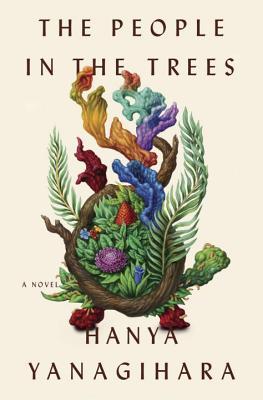
The People in the Trees – Hanya Yanagihara (2013)
After reading both of Yanagihara’s novels I have come to the conclusion that she’s a humanist. Though perhaps not in the way I’d expect. Her two books are not the slice of life novels that I would typically associate with the genre. They are not stories about ordinary people. Instead, Yanagihara has spent her first (and for now, only) two novels chronicling exceedingly tortured and uniquely exceptional lives. Her second novel, A Little Life, is one of the most deeply painful and empathetic pieces of literature I have ever read. But it achieves this feat in a unique way. We do not come to grieve for these characters because we have attached ourselves to a group whose lives resemble our own. Instead, Yanagihara paints a portrait of four profoundly unordinary people. We watch as the most improbable events occur in their lives. They all become obscenely professionally rich and successful and they die in increasingly tragic ways. And it’s all centered on Jude, a character who perhaps has the most singularly painful existence of any fictional person I can recall. It is through all of these drastically exceptional circumstances that at the end of the novel we are still deeply moved. Through it all, you come to value these characters’ humanity over any other quality.
The People in the Trees is not about an ordinary person either. It is styled as the memoirs of one Abraham Norton Perina, M.D. He is a man that not only discovers a syndrome that causes immortality in the afflicted, but is also serving a prison sentence for sexually abusing his adopted children. The novel is introduced almost as an update on Lolita. We are to read the account of an unquestionably brilliant man and must come to grips with the fact that he is, of course, a monster. And while this is the tension at the center of the novel, I believe Yanagihara is perhaps doing something else here.
On the one hand, we see a modern miracle. This novel chronicles the discovery of an unknown island, people, and culture that hold the key to immortality. And yet it is presented through the lens of a thoroughly pragmatic and un-romantic narrator. It’s this contrast that really lets the reader grasp the wonderment in ordinary life. It leads you to think about all of the impossible things that have been accomplished in reality. All of the seemingly impossible miracles that we take for granted. And yet, it must also make us think of humanity’s unfailing ability to crush these miracles.
The island in this novel becomes increasingly modernized and eventually ruined. The turtles, the key to this immortality, are over-researched and go extinct. The centuries-old culture of these people is lost forever. It is replaced with Christianity and alcohol. And of course, lurking at the back of this novel is the acknowledgment of the monster within our narrator himself. What I think maybe separates Perina from the narrator in Lolita though, is that I don’t think Yanagihara ever intends to make Perina likable. He’s arrogant, petty, jealous, and of course, a convicted pedophile. So what is she doing? I think this novel is again, a unique way to chronicle what it is to be human. This novel presents us with the most inspiring aspects of what it is to live in the world, and also the most horrific.
I really, really liked this novel, almost in spite of myself. Given its approach, I’m just surprised at how much I enjoyed reading it. Not that there’s anything wrong with what Yanagihara sets out to do. I just mean that I’m not like a massive Lolita fan or anything. But her writing in this novel is truly remarkable. In both of her novels, she’s completely surprised me. She has quickly become one of my favorite writers.
August
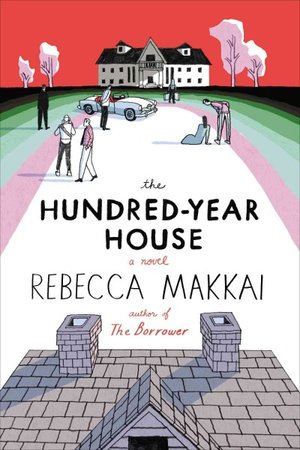
The Hundred-Year House – Rebecca Makkai (2014)
I had given this novel to my mom as a gift after she (and I) had loved The Great Believers. But as she was reading it, she seemed pretty lukewarm. Not necessarily knocking the book but insisting that it was much different than The Great Believers. All of this to say that going into it, I was a little skeptical. I really shouldn’t have been! This novel is indeed different from The Great Believers but it is still expertly mapped out and incredibly well-written. My main takeaway from reading this was much the same as it was for Hanya Yanagihara’s The People in the Trees: that this is an important writer to watch.
So what sets Rebecca Makkai apart from other contemporary writers? I’d say that two main things jump out to me. First, is that she seems to have such a warmth and understanding for her characters. As much as it is a cliché, there is really something about her characters that feels so genuine. This is more transparent in something like The Great Believers, a story about gay men facing the AIDS epidemic in Chicago. The characters in that novel are not only likable, they’re constantly facing death. How could you not root for them? But this isn’t necessarily the case in The Hundred-Year House. The novel is split over the course of three distinct timelines (1999, 1955, & 1929) and centers on the residents of (you guessed it) one house. And in the first timeline that Makkai presents us with (1999), the characters are in fact, largely detestable. They’re all pathetically self-involved, struggling intellectuals. Their only focus is their own goals. Moreover, they do shameful things to achieve them. These are not the same likable people as The Great Believers. Yet, I have to admit, I do like them. They’re so real, so flawed, and so pathetic. Their antics and interactions are hilarious. Reading this section, you just get the sense that Makkai is unique in her ability to capture people at their best and their worst.
The following two sections do read a bit more like The Great Believers. The characters are far more likable. This is in part because, like The Great Believers, we know their inevitable fate. Which brings me to the second main strength of Makkai’s: plotting. It may sound simple enough, but really, the two novels I’ve read by her have been flawlessly executed. In The Great Believers, I was skeptical of the two timeline structure. But, I have to admit, she used it at the climax of the novel to great and tragic effect. It was not just a clever storytelling device to create suspense. It subtly informed the reader along the way so that at the end, the emotional payoff would be greater than simply understanding the events of this story.
She does this masterfully in The Hundred-Year House. As I’ve said, the novel is split into three timelines, traveling further back as we read. Thus, we generally know the broad strokes of the 1955 and 1929 stories before we read them. But Makkai is able to insert so many surprises, twists, and clever little ironies. It’s not as if she’s using it to throw a curveball at the reader. The major events of each story culminate how we expect. The 1955 storyline ends with the protagonist dying in a car crash (something we already knew) and the 1929 storyline ends with the arts colony being preserved for another 25 years (something we already knew). But what Makkai does instead, is to subvert the tiniest of details. What’s behind a boarded wall? Who was Edwin Parfitt? Who painted the landscape that hangs in the attic? These are the reveals that turn out to be surprises. And they don’t drastically change any of the information we have. But it adds so much life into the novel. It feels like magic!
Before Hollywood: From Shadow Play to the Silver Screen – Paul Clee (2005)
Gioia had rented this from the library after reading Hugo. She thought I should check it out because of my interest in movies. I was a bit wary just because this book only covers the evolution leading to movies. It ends at Hollywood. But to my surprise, this book was not only informative but really enjoyable. I haven’t read any type of history book since college. After this, I think it may be worthwhile to revisit that. I don’t have much in the way of critique for this particular book. After all, it’s pretty much just information and as I’ve said, Clee presents it really well. If I have a critique, it is just that I’m still curious to know more about the invention of photography. Clee discusses it in some detail but I suppose I’ll just have to read more about that. Not necessarily a bad thing. So in lieu of a usual review, I’m just going to present the most fascinating things I learned from the book below:
- The first ancestor to motion pictures is the camera obscura first alluded to by Johannes de Fontana in 1420. Its first description is made by Leonardo da Vinci in 1500. This device is essentially a giant box that uses light and shadow to reflect an image.
- The next major evolution is the magic lantern invented in 1656 by Christiaan Huygens. This was a camera obscura outfitted with a condensing lens, a focusing lens, a light source, and a mirror. It was able to illuminate a projection of an image.
- The use of magic lantern enters the public. Shows such as phantasmagorias combine projected images with music and practical effects (such as smoke and lights). They are also used to make projections that become panoramas.
- In 1826, a camera obscure is used to produce the first photograph – an image on paper that is permanently fixed. Louis-Jacques-Mandé Daguerre does the same fixing photographs on small metal plates. The first practical type of photography. These photographs are improved until things can be photographed in rapid succession. Because of the permanence of images, this can be manipulated to simulate motion.
- In 1885, George Eastman invents film. In 1888, Emile Raynaud creates perforations on his film so they can be run through a projector in fast motion. These are the first animated films.
- In 1895 Max Sklananowski shows the first films of everyday life in Berlin. A month later, the Lumière brothers show theirs for a paying audience at the Grand Café in Paris. These are all short films of everyday life, Workers Leaving the Lumiére Factory, Watering the Gardener, etc.
- George Méliès is in the audience. In 1896 he begins making the first of his “trick films,” the fist films with special effects. This culminates in 1902 with A Trip to the Moon, a narrative film that is the first science-fiction movie. in 1903 Edwin S. Porter’s The Great Train Robbers is the first western.
- In 1905 the first Nickelodeon opens. In 1911 the first film studio in Hollywood opens.
September
Jane Eyre – Charlotte Brontë (1847)
Jane Eyre is a classic. It’s probably one of the ten or twenty most famous novels ever written. That is all I knew about it going in. That’s obviously a lot left to fill. My first impression is plainly that Charlotte Brontë is a master novelist. She doesn’t have the most exciting prose. And I wouldn’t say that Jane Eyre is even a very exciting book. On the contrary, I was a little surprised by how little happens given that it’s a 500+ page novel. So why does Jane Eyre work so well? I think it’s mostly because Brontë so perfectly captures her protagonist and narrator. Jane Eyre is one of those books where you like the protagonist so much that you just can’t help but root for them. My feeling for this title character is really all that kept me moving page after page. And by that, I don’t mean to slight the other aspects of the novel. Brontë’s prose isn’t limited for lack of ability. It’s rendered to perfectly suit her narrator. The same goes for the events of the novel. This is a book about the interior passion of a 19th century working-class orphan. Even if there’s not a lot of action happening, there’s more than enough emotion in this novel. It reminded me in many ways of Little Women. Again, not a whole lot happens in Little Women. Louisa May Alcott’s prose is even plainer than Brontë’s. And yet her protagonists are captured so vividly, it’s a wonder to read. There are a few things that I didn’t love about the novel. I was surprised by how hard of a turn Brontë leans into Christianity towards the end. And there are statements about India and Asia that are gross to read by today’s standards. But given the time that this was written, I really can’t emphasize enough how impressed I was by it. Brontë breathes so much life into this novel, it’s not surprising it has withstood the test of time.
The Sopranos Sessions – Matt Zoller Seitz & Alan Sepinwall (2019)
This is the best companion book I have ever read. Admittedly, I haven’t read many of them. Most notably, The Wes Anderson Collection (also by Matt Zoller Seitz). But I think this book really accomplishes what any book in this genre should do. To provoke, inform, and critique a work of art. The success of a book like this is obviously heavily dependent upon the art itself. Fortunately, for a couple of reasons, The Sopranos is pretty easily the best television show you could choose to cover:
1. It is (arguably) the greatest television show of all time.
2. It almost perfectly straddles the line between intent and interpretation. A show like Breaking Bad is certainly worthy of the same amount of criticism. I plan to read Alan Sepinwall’s book covering it when I re-watch that show. But (without reading said book) I’d imagine deciphering Breaking Bad isn’t nearly as much fun as deciphering The Sopranos. Things in Breaking Bad tend to be what they are. It’s exquisitely done, it is probably the most visually perfect show ever made, but it’s not ever very opaque. Now, the opposite would go for something like Twin Peaks, a show I am inclined to think is almost too opaque for similar criticism.
But the strongest part of this book, by far, is David Chase’s willingness to discuss the show. I am astounded by how much Sepinwall and Seitz got out of him. These interviews (which cover each season of the show individually and span 85(!) pages) are worth the price of the book alone. Chase’s thoughtfulness about the show and his honesty about the very human aspect of making it were incredibly eye-opening to me. I don’t know what else I can say. I am sad to have finished the show. I am sad to have finished this book. Luckily, I think reading it will make The Sopranos stick with me. What else could you want from a book like this?
Blood Meridian or the Evening Redness in the West – Cormac McCarthy (1985)
One of the things I’m most proud of over the last couple of years has been really developing and discovering my taste as a reader. Until quite recently, I had a hard time differentiating between whether or not something was good and whether or not I liked it. I’m not sure I even understood that those things could be different! I have to assume this is the struggle of many a pretentious white dude. The literary canon is so engrained and so esteemed, it feels impossible to disagree with it. How are you supposed to read something like Ulysses (though I actually do quite like Ulysses) and say, “You know what, I think that book was pretty boring”? Even if that’s how you truly felt, you’re going against every significant piece of criticism over the last 100 years.
So here it is, I’m not sure I like Blood Meridian. And yes, I understand that most people consider it to be the best book of the late 20th century. I realize that Harold Bloom (which by the way, fuck Harold Bloom) considers it to be a pinnacle of literature. But I have to stick to my guns. I don’t think I really like this novel and I don’t think the fact that I disagree with the canon necessarily makes me wrong.
I read Blood Meridian almost as a response to novels like Lolita and A Clockwork Orange. I have no idea if McCarthy had any intention of responding to those books specifically. His more obvious target seems to be American myth making and the western. Still, those books are instances in which an author challenges the reader to recognize the humanity in even the most horrible and depraved of characters. Blood Meridian, on the other hand, looks at a historical events and says “there was never any humanity here.” And when I say that, I don’t simply mean that McCarthy shows nihilism triumphing over humanity (although that is in a sense what happens at the end). I mean that McCarthy presents an entire novel, a historical epic no less, in which he denies the reader even a shred of humanity in its pages. The central protagonist, known first as the kid and later as the man, does not have an interior life. No other character in this novel has an interior life. The only character with a compelling point of view is the judge. By the end of the book you realize that his point of view isn’t based upon anything but opportunity and self-preservation. There’s no logic or grand design. He just uses bullshit and misinformation where it’ll advantage him.
The more I write this out, I am compelled by it. I don’t think McCarthy’s thesis is necessarily bad. In fact, I think it may be a radically honest look at history. But, as I said before, it doesn’t mean I have to like it. One of the things I’ve discovered about myself is that I am probably a romantic or humanist. Or, if not those things, certainly drawn to those movements. There’s a reason my favorite books I’ve read this year are A Little Life and The Great Believers. Ironically, I think McCarthy approaches this type of literature in many of his other books. Suttree is a novel I quite like for its characters. The film No Country for Old Men culminates in an expression of remorse for how humanity has fled the world. Even The Road ends on a (small) note of hope.
I should also note, I’m sure I missed quite a bit of what’s happening in this novel. McCarthy’s narration is so obfuscated, muddled, and at times outright bizarre. An enormous part of Blood Meridian’s lasting legacy has to be that you could unpack it forever. I’m excited to see Wills’s final thoughts on the novel and see if it sways me. As a major piece of literature, I’m glad I read it. But as of now, I’m not sure I liked it.
Wuthering Heights – Emily Brontë (1847)
In Rebecca Makkai’s The Hundred-Year House (see above!) a character makes a passing reference to Jane Eyre. Reading both Charlotte and Emily Brontë had already been on my to-do list this year. Reading this line (even in passing) made it feel like the perfect time to start, and so I read Jane Eyre (again, see above!). There is perhaps a bit of irony then that it is not Jane Eyre but Wuthering Heights that Makkai’s novel most closely resembles.
I have to say that I’m quite surprised about my feelings about Jane Eyre vs. Wuthering Heights. First, I should note that each of these novels stand on their own. They’re both landmark works. They are both readable as masterpieces, even today. This is not a situation in which only one can have staying power or that they must always be compared against each other. And I hope that’s not what I’m doing, inadvertently or not. But given that they are two novels written by a pair of sisters under a pair of pen names in the same year and that I have read them in succession, I’m going to compare notes.
The thing that most surprises me about the two novels is how wildly different they are. Truthfully, the similarities between these books only exist in the points I’ve made above. In their actual text, the novels couldn’t be more different. Jane Eyre follows the titular character over a period of about 20 years of her life. She’s our sole narrator. Very little happens. The testament of the novel is that her strength of character withstands the circumstances of her world. The power of the book is that Jane Eyre stays the same despite every possible pressure and opportunity from the outside world to become corrupt.
Wuthering Heights, on the other hand, spans a period of about 40 years and covers the (often violent and always nefarious) interactions between three generations of two families. There is no central protagonist. In fact, there are three different narrators who are all biased actors within the story. The plot of Wuthering Heights is almost the exact opposite of Jane Eyre. The power of the novel seems to be precisely how the world overpowers and shapes every one of these characters. Each character, despite their intentions, is corrupted into jealousy, resentment, or revenge by their circumstances. Unlike Jane Eyre, every character here succumbs to these temptations.
On paper, I should like Jane Eyre much more than Wuthering Heights. Jane Eyre is really my favorite type of book. A close portrait of humanity that focuses on character over plot or action. Wuthering Heights is a soap opera. But strangely enough, I just love Wuthering Heights. It’s easily one of my favorite books I’ve read this year. I can’t remember a novel with a plot so wild and convoluted. I can’t remember a novel that embraces chaos in the way it does. But even in this absurdity, there is something so true about it. I think it comes back to what I admired so much in Makkai’s book. That the past is constantly shaping our present. I don’t know if a novel has ever captured that as clearly as Wuthering Heights.
Mike Leigh: Interviews – Ed. Howie Movshovitz (2000)
Mike Leigh has rapidly become one of my favorite filmmakers. After spending so much of this year watching his films, I thought I should read up on him. This book is part of the “Conversations with Filmmakers Series” published by the University Press of Mississippi. It’s a series that I will certainly be returning to. Essentially, this book is a collection of interviews and profiles done by various newspapers and magazines. It’s an immensely worthwhile collection for anyone interested in the subject. By reading the book, I got to read how the press covered Mike Leigh and his films from Abigail’s Party in 1977 to Secrets & Lies in 1996. I also, in most of the pieces, got to hear Leigh’s own thoughts and see how they have developed or stayed the same over time.
I think a book like this is perfect for getting a fundamental sense of the subject. With Mike Leigh for instance, every piece inevitably touches on the same points: that he was born straddling the line of upper and lower class by being the son of a Jewish doctor in Manchester, that he has an idiosyncratic filmmaking method born out of his work in theater, and that he is both deeply thoughtful and quite protective of his work and collaborators. By reading something like this, you can almost distill exactly what the book thinks makes Leigh unique. But I have to admit, by the end reading these same facts gets a bit tedious. Still, almost every one of these pieces was informative in some way. And the collection is edited so the interviews cover his various work. Thus, while the initial profile of Leigh remains constant, at least the subjects are somewhat different. One will cover Mean Time, and another will cover Career Girls, for instance. As I said, I think I’ll definitely return to this series. The list of filmmakers they’ve covered is quite impressive. I also think I’ll return to reading more on Leigh. But perhaps in a biography or a more in-depth piece of criticism next.
The Left Hand of Darkness – Ursula K. Le Guin (1969)
I was knocked out by this book. A lot of that has to do with me. I, shamefully, wasn’t aware of this novel or even of Le Guin. Thankfully, better-read people seem to understand Le Guin as one of the most important and best sci-fi writers. It’s easy to see why. The Left Hand of Darkness is one of the best fantasy/sci-fi books I’ve ever read. It’s really right up there with Harry Potter, Game of Thrones, or The Lord of the Rings. However, I think the closest comparison for the novel is actually with a book that I am not a huge fan of: Dune.
There are countless similarities between Le Guin’s novel and Dune. They’re both landmark sci-fi novels. They were released only 4 years apart. Their plots, in some way, cover competing factions who battle over the best way to govern a planet. And, importantly, Le Guin and Frank Herbert each use their novels as settings to explore political ideas and themes that reflect the “real world.” I should also note here, that each of these novels handles these themes and ideas deftly. They’re novels first, not political manifestos.
So what makes me like Left Hand of Darkness so much when I didn’t love Dune? In many ways, I think the novels are two separate approaches to the same goal. Two sides to the same coin, you might say (The light to the left hand’s darkness you might say after reading this novel.) Dune takes a broad and epic view of its world. We meet Paul. He’s the chosen one, a literal messiah. The novel chronicles his political exile and rise as the leader of a rebellion. It ends as he takes back his kingdom. The novel’s scope allows for Herbert to explore weighty, global themes such as environmentalism and fascism. But in doing so, he leaves very little room for humanity. To me, the failing of Dune is that it leaves out its most interesting part. Just as Paul reaches the Freman, the novel jumps in time. We miss the period of him learning a new way of life. We miss the period of him rising as a leader. In other words, we miss the most human aspect of the journey.
The Left Hand of Darkness, on the other hand, is all about this humanity. Although the novel chronicles the journey of a singular envoy to a foreign planet, it’s not really about that. The novel, instead, is about the relationship between this envoy and one of the planet’s inhabitants. It’s about how, despite being completely different species, there’s a shared experience of being alive. Herbert’s novel skips the journey in favor of reaching his resolution with Paul retaking his kingdom. Le Guin’s novel sets up her envoy’s mission only to close the novel before it’s resolved. She does the opposite of Herbert! She focuses on the journey to the point that she literally eschews the destination in favor of it.
Another comparison I keep coming back to with The Left Hand of Darkness is to the film Arrival. Perhaps a fitting one given that its director, Denis Villeneuve, is set to make the Dune film. Arrival is a movie I admire because it takes an extraordinary event and tries to extrapolate what our response to it would really be like. If aliens landed on earth, how would we communicate with them? How would different countries handle this event? What would the media response be? The Left Hand of Darkness, I think, takes a similar approach. And for what it’s worth, Le Guin is asking even weightier questions. How does the role of gender affect our daily lives? How does repressed sexuality affect us? What would it look like for a society to do away with gender divisions? The key to this approach, is that Le Guin isn’t merely doing this as a thought exercise. She uses these questions as the entry point to craft a moving and deeply felt novel. The novel isn’t extraordinary simply because of its scope or premise. It’s extraordinary because of Le Guin’s singular ability to understand and reflect the humanity of her readers.
We Need to Talk About Kevin – Lionel Shriver (2003)
I do not like this book. I think in a lot of ways it is a base exploitation of the worst tendencies in people. It’s a book that preys upon the compulsion people have to watch the news anytime there’s a mass fatality. It’s a book that works in the same way that Keeping up with the Kardashians works. It dangles a trivial piece of information in front of you until you’ve given yourself over to it. All the while, the book knows that it doesn’t have the answers you seek. Nothing has these answers. On top of all of this, I don’t like Lionel Shriver. From what I’ve read, she honestly seems like an edgelord. I think the politics of this novel range from complicated to offensive.
And yet, I read this book in a week. She totally got me. More importantly, all of things that I’ve just criticized this book for being are purposeful. They’re part of Shriver’s design. This is a novel about a mass shooting after all. I’d be lying to say that I wasn’t completely compelled by this novel. I’d be lying to say that I wasn’t reading as fast as I could to get to the end. I needed to know how this incident occurred, even if it doesn’t ultimately matter. So whatever I criticize this book for, I have to recognize that it’s a quality that exists within me. I can act high and mighty and shun Keeping up with the Kardashians. It doesn’t mean that show doesn’t have the same hypnotic power over me that it does over everyone else. It just means that I’m choosing to ignore it.
What does this all mean? That the book is good? I suppose so. If I have a valid criticism of the book, it’s that I think the twist at the end is a cheap trick. One of my biggest pet peeves is when the twist in a movie or book is born out of the framework or design of the story as opposed to the story itself. It’s the same problem I have with Westworld. The twists there don’t occur out of any logic within the story. They occur because Jonathan Nolan thinks they’d be cool.
So there it is. I think any other criticism I could hurl at this book would stem from my personal feelings about it. Not, ultimately, about whether or not the novel actually works. It obviously does. That doesn’t mean I have to like it.
October
The Lying Life of Adults – Elena Ferrante (2019)
It seemed like the reviews of this novel were fairly mixed. I think The New Yorker, in particular, gave a somewhat negative review. After reading this novel, that is quite surprising to me. Not just because this novel is good, which it is, but because it is so in line with the rest of Ferrante’s work (or at least the five novels I’ve read). In some ways, this novel reminds me of those stories about computer programs who are trained to watch every batman movie and then write a script. This novel centers on puberty, adolescence, deception, class, and budding sexuality all from the point of view of a young Neapolitan woman. What else would you want?
To be fair, I do think there are some significant differences between this novel and Ferrante’s other work. To some extent, The Lying Life of Adults feels more like an explicit piece of literature than any of her other writing. The Neapolitan Novels, for instance, do have the hallmarks of great works. But those novels’ grand themes develop and exist over the course of four books and their characters’ lifetimes. They feel far closer to life than anything precisely plotted out. There’s a perfect messiness to them.
The Lying Life of Adults, on the other hand, has an almost exact symmetry to it. Each event is mirrored by another episode in the novel. Take the novel’s central tension. Giovanna becomes distraught when she overhears her well-to-do, academic father compare her to her estranged, no-good Aunt Vittoria. Giovanna goes on a quest to meet this aunt to determine whether or not she is truly like her. As this quest proceeds, she discovers that she does indeed have some admiration for this aunt. She has to navigate the complexity in evaluating this relative who despite having an affair with a married man, has also reconciled with his family. As she starts to see that this estranged family member isn’t all bad, she learns that her parents aren’t all good either. Her father has been carrying out an affair with his best friend’s wife.
Giovanna is stuck in a crisis. At first, the tension seemed to be whether or not to live as a good or bad person. After examining her family, Giovanna sees that those distinctions don’t exist. She’s stuck. Every decision that she makes seems like it could condemn her to the fate of her father or her aunt. Both of which are thoroughly undesirable. This culminates as Giovanna explores her desire for her friend’s fiancé, Roberto, an academic who has left his lower-class Neapolitan neighborhood behind. He’s a literal stand-in for Giovanna’s father. Moreover, if Giovanna does sleep with him, she becomes like her aunt. The decision to seduce him would mirror the worst qualities in both her father and her aunt.
So what does she do? Giovanna ends the novel by rejecting both of these paths. She instead pursues Rosario, a young man who would go against the wishes of both Vittoria and her father. The novel ends as he takes her virginity. It is gross and ugly. The scene is at once, thoroughly un-romantic and yet, perfectly placed. It feels both true to life and meticulously plotted. It’s the best of both worlds.
The Poisonwood Bible – Barbara Kingsolver (1998)
This has to be one of the better reading experiences of my life. I got this book through a donation box meant to go to the dump and decided to read it on a whim. Thank god! It’s so good and, in so many ways, is right in my wheelhouse. One, this book in some sense is a commentary or an update on Little Women (maybe the best book I read all of last year). Its chapters are all told from the various perspectives of four sisters. Two, as you could probably guess, this book is specifically about people. Sure, it’s centered on a failed religious mission to the Congo, but it’s really about the lifelong experiences of these girls as a result of it. I think the greatest achievement of this book is how Kingsolver captures her four protagonists. They’re all distinct, incredibly charming, and if not likable, absolutely compelling. Third, Kingsolver is somehow able to use this novel as a Trojan horse to write about U.S. interference in Africa. This novel somehow becomes political before you even realize it. What’s more, these are incredibly complicated subjects and politics to tackle. Kingsolver is a white woman and each of her four protagonists are white women telling a story about Africa. This could have been offensively bad. I don’t think it is. In fact, I think Kingsolver navigates these issues masterfully. The perspectives of her protagonists become its greatest strength. This novel is not so much the story of Africa under U.S. interference, but the story of U.S. interferers in Africa. I should say here that I am of course a white American boy. Please come at me if this book, or Kingsolver’s perspective, is indeed problematic or more complicated than I make it out to be. As much as I try to investigate these things, I am not the most qualified to do so. But I really have to say that I just have an inordinate amount of admiration for this book. It’s witty, charming, funny, moving, and again, so informative. I can’t think of many books that do as much as The Poisonwood Bible. I can’t wait to check out more of Kingsolver’s work.
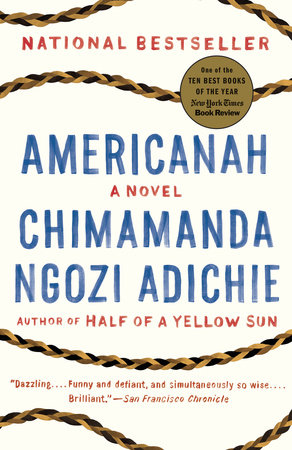
Americanah – Chimamanda Ngozi Adichie (2013)
This is an incredible novel. It’s rare for a book to feel so real and utterly life-like as this one did. In fact, the only books I’ve read this year that fit this description are A Little Life and The Great Believers, two of my favorite books ever. What’s more, this novel tackles the lives and experiences of two Nigerians, Ifemelu and Obinze. It’s an experience that is largely unfamiliar to me. Yet Adichie’s writing is so honest and so compulsory, it transfers seamlessly across lines of experience, history, and especially race. Which is not to say that this novel reads the same to me as it would to a Black American or, as Ifemelu identifies herself as, a non-American Black. I doubt that it would. But I think a huge part of the appeal of this book to me is that it identifies, portrays, and grapples with situations that I am unfamiliar with as a white American. Reading something like this is enormously powerful in that it actively changes my thinking. I can’t help but think about the trials of immigration, both legal and illegal. I can’t help but think about how often extremely smart, capable people must be reduced to roles beneath their capabilities in our society based solely on the color of their skin or where they were born. And in fact, that might be what’s most impressive to me! Adichie accomplishes all of this within the context of an enormously successful novel. As I said before, this novel undoubtedly reads much differently to me than it would to say, a Nigerian who has immigrated to America. Regardless, this novel is still brilliant even as just the love story of Ifemelu and Obinze. It’s that good! I don’t know what else I can say. I loved this novel. It seems like Adichie is really one of the most prominent writers of this past decade. I can’t wait to read more of her work.
Sing, Unburied, Sing – Jesmyn Ward (2017)
I am going to begin by looking at this novel in conversation with Toni Morrison’s Beloved and the works of William Faulkner. For me, these influences loomed over the novel to the point that it affected my perception of it. In other words, my reception of Sing, Unburied, Sing was influenced as much by these novels as it was by the contents of the book itself.
And to start, I think I should look at whether or not this impact was warranted. Let’s begin with Faulkner because from the first sentence, Ward’s writing evokes him. Her prose is lyrical and musical. The chapters are written from the point of view of its characters. What’s more, these points of view are distinctly complicated and colored by the consciousness of their respective characters. JoJo speaks from the perspective of a boy, Leonnie from the perspective of a drug-addicted mother, and Richie from the perspective of a ghost. On top of that, this novel takes place in Mississippi, the setting of Faulkner’s work. Which is not to say that Mississippi isn’t a big enough place for more than one writer. That’s preposterous. But it’s significant that Ward sets her novel, one that uses the writing style popularized by Faulkner, in the place of Faulkner’s work.
So what about Beloved? Just as the style and setting largely reflect Faulkner, I think the plot and subject matter directly reflects Toni Morrison. Beloved is a novel dealing with how the ghosts of slavery haunt its characters. Sing, Unburied, Sing tackles this same issue. Now, slavery is the fundamental legacy of this country. The sin of it looms over all aspects of our life, and therefore our literature. I don’t mean to suggest that by tackling this issue, Ward is automatically evoking Beloved. But, I think the fact that she chooses to illustrate this theme through the haunting of an actual ghost, just as Morrison does in Beloved, warrants comparison.
Okay. So let’s say that Ward is intentionally invoking these works to inform Sing, Unburied, Sing. What does that mean? Every novel invokes something else. Ulysses, which most people consider to be the greatest modern novel, is a chapter-by-chapter parable of The Odyssey. And in fact, that is in large part why critics consider it to be so masterful. By connecting itself to another work, it opens itself up to a multitude of interpretations and readings. Likewise, I think that Sing, Unburied, Sing benefits from these two connections. Ward choosing to update Faulkner is meaningful because her novel centers on Black characters, people and perspectives that are ignored in Faulkner’s work. Likewise, Ward’s connection to Beloved feels similarly necessary. Beloved is set in the immediate aftermath of slavery and the Civil War. Sing, Unburied, Sing is set in the present day. The message is unmistakable. Ward is showing how the legacy of slavery is still with us.
I think Sing, Unburied, Sing is an exceptional novel. And as I’ve just laid out, I think the weight of the influences it carries is more than justified. However, part of me is still curious to see what Ward’s writing would look like if it stood a little more on its own. Her prose and imagery are so exceptional. Despite the strength of this novel, I’m left wanting to read something by her that’s not so directly tied to other works. Luckily, she does have two other novels which I plan on checking out.
November
 Queenie – Candice Carty-Williams (2019)
I added Queenie to my list after seeing it recommended again and again in connection to Americanah. And to some extent that makes sense. They both tell the story of women dealing with love, work, and relationships all with a particular emphasis on the perspectives of Black women. I think it’s important to note too that they were both enormously popular and critically-acclaimed novels written by Black women. Something that is unfortunately pretty rare. However, I also think it’s important to note that after these similarities, both are very much their own book. They have about as much to do with each other as books by Dave Eggers and Jonathan Franzen do. So in light of that, I’d like to evaluate Queenie on its own terms.
The thing that stands out to me most about Queenie is how centered it is in the current moment. Writing this, I’m beginning to realize that I’ve hardly read anything with a focus on what life is currently like. Most of the books I’ve read recently were either written decades ago, or are centered in that time. Queenie was written in and is centered in the current moment. It touches on dating apps, sexual health, the #MeToo movement, and Black Lives Matter. There’s a reference to Dua Lipa for goodness sake! Moreover, the story is told in various forms. Sometimes that is traditional prose. Just as often it comes in the form of emails, group chats, and dating app messages.
To me, this was a bit overwhelming. I have the inclination to say that while I liked this book, I found it uneven. But I’m not sure this true. Objectively, I think this novel is quite consistent in its theme and story. It’s really the story of Queenie’s intense struggle stemming from a breakup. It reminds me quite a bit of Elena Ferrante’s Days of Abandonment in that way. The difference, I think, is that Ferrante only focuses on the breakup in her novel. In Queenie, Candice Carty-Williams uses this breakup to write about issues of mental health, trauma, identity, and sex. It’s really not uneven, it’s just broad.
I’m curious to see how I’ll feel about this novel in time. While I like it already, I’m guessing it’ll only grow on me. I think most of my hesitation to love this book just comes from how modern and hyper-referential it feels. I feel resistant to the idea of a book filled with text messages, emails, and Netflix references. Which is stupid. That’s what life is like. In a lot of ways, Queenie felt more like a TV series to me than a book. And I think that’s okay. After all, I love TV.
Jazz – Toni Morrison (1992)
This was going to be another book club book, although I think the general stress around the election and pandemic may have derailed that. Still, I’m glad I read it. In fact, I think it’s probably my favorite of Morrison’s work that I’ve read so far. The fitting thing about this being a book club book is that its most striking feature is its narration. And that was the case for our previous books, Their Eyes Were Watching God, and Blood Meridian, too. In Jazz, Morrison details the aftermath of the murder of a young girl, Dorcas. The odd part is that there’s no mystery to it. From the beginning we know what happened and who did it. Still, Morrison uses this event to explore the humanity and histories of everybody involved. This includes Joe Trace, Dorcas’s former lover and murderer, Violet, Joe’s wife who attempts an attack on Dorcas’s body at the wake, Dorcas herself, as well as her friend, Felice. From these individual pieces, our collective understanding of the events and these people grow. These sections of narration build upon each other (perhaps in an attempt to mimic the style of Jazz music) to give us a more complete understanding of the whole. The most fascinating and perplexing part, to me, is the way some of these characters’ histories overlap. This centers, in particular, around the character of Golden Gray, a mixed race character that appears in both Violet and Joe’s histories. I think I’d have to re-read this novel in order to fully comprehend the details of this connection. There’s a lot going on, and I don’t think you really can understand the scope of all of these events and histories until the end. Still, there’s a lot to take away from an initial reading. So much of this novel seems focused on style. I wonder if perhaps understanding the rhythm and feeling of the book is ultimately more important than the details anyway?
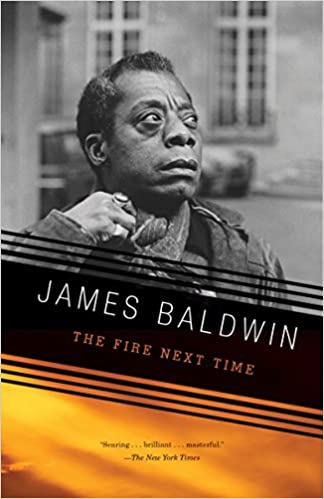
The Fire Next Time – James Baldwin (1963)
There is no way I’m going to be able to capture even a fraction of Baldwin’s argument and purpose here. The Fire Next Time is the most honest look at race and the experience of Black Americans that I have read. It belongs in the same realm of literature as our country’s founding documents, things like the The Declaration of Independence or The Federalist Papers. As such, I think a truthful reading of it would be to examine it like those other articles: As a comprehensive thesis and argument to be pored over. At least for now, I’m writing after reading this book just once.
There are two main components to this book. The first section, “My Dungeon Shook: Letter to My Nephew on the One Hundredth Anniversary of the Emancipation,” is almost like a prelude. Baldwin writes this letter and details the ways in which his nephew reminds him of his brother and father. He relates what living as Black men in America has done to these fore-bearers. And he implores his Nephew to have pride in himself as a Black American. To not believe what American society says about him through its words and actions every day.
The second, and lengthier section, “Down At The Cross: “Letter from a Region in my Mind,” is a far more comprehensive look at this sentiment. Baldwin details his experience as a young Black man. How as he entered adolescence, he realized that his opportunities were narrowed and almost entirely bleak due to his race. He realizes the intrinsic anger and suffering this country has embedded in Black people as well as the ways they have been forced to cope: through drugs, alcohol, and even the church. And Baldwin finds a brief refuge in the church. He becomes a dedicated youth pastor and leverages this position to pursue education. He quickly realizes though that the church is really just another institution subjecting Black people to a false sense of white superiority. He details how the church attempts to strip his intrinsic humanity as a Black man in order to achieve a white idea of salvation. And he notes the blatant hypocrisy in this pursuit. He notes how the church, throughout its existence, has been synonymous with power. And specifically, with white people and nations using it to degrade the humanity of so-called “infidels.” He notes how Christianity was used as the driving force behind the institution of slavery and the Holocaust. That the only people who need this salvation are the white Christian perpetrators of these atrocities.
Baldwin moves from there to a dinner he had with Elijah Muhammad in which he was confronted by the aspirations of Black American Muslims. While Baldwin seems drawn to this movement, he notes it is in a similar sense to which he was drawn to the church. Because it is a movement testifying to a truth and a salvation he finds appealing. But Baldwin goes on to note some of the fundamental problems of this movement. That while they may not be wrong in their assertion that white Americans are bankrupt, they are pursuing a similar path as white supremacists. That they want a separate and segregated nation. Baldwin notes that unlike white Americans, Black Americans are entitled to these things. That they have been in this country the longest, building it for 400 years without having their rights has human beings recognized. But Baldwin doesn’t believe this is the solution either.
What Baldwin believes is the path to salvation is for Americans, white and Black, to truly examine and accept American history. That America will never be able to move forward if it doesn’t acknowledge the fundamental issue of race in this country. And this in large part, has to do with accepting the fundamentally corrupt way our society has been structured. That we cannot continue to look at the solution to this country’s problem with race as Black people achieving the status of white people. The only thing that white Americans have that Black Americans don’t is power. It is white Americans that need to repent to achieve the humanity of Black Americans. They are the ones who are in need of redemption. The title of the book comes at the end, in a quote, from the Bible. Baldwin compares the state of this country to that of Noah on the arc. That this time God has sent water, but if we don’t fix this issue soon it’ll be too late: “No more water, the fire next time!
All the Pieces Matter: The Inside Story of The Wire – Jonathan Abrams (2018)
I’m not sure I’ll have a whole lot to say about this book that I haven’t already covered in my Television Log posts about The Wire. This book is fantastic. It felt like a perfect companion. I find everything about The Wire to be so inspiring. Getting to hear the story of how it happened, told by all the people who made it, is thrilling. By the end of the book, I was having the same feelings that I had at the end of the show. Mainly, that all art should be this progressive, reflective, considered, and important. The show is the type of thing that makes you want to change your life and this book does an amazing job of capturing that aspect of it. I’m glad I watched the show and I’m glad I own this book.
December
Alright, Alright, Alright: The Oral History of Richard Linklater’s Dazed and Confused – Melissa Maerz (2020)
I obviously think this is an extraordinary document. It’s literally a 400+ page book covering the development, production, and aftermath of my favorite director’s most well-known movie. To be honest, I felt pretty indulgent at times reading it. It was a similar feeling I had to when I was reading Lizzy Goodman’s Meet me in the Bathroom. Like, this is way too much fun to count as actual, honest-to-god reading. But I don’t mean to take anything away from Melissa Maerz or Lizzy Goodman by that. In fact, I think here it’s a real testament to Maerz’s work. The fact that this book is so fun and easy to read is kind of insane. She’s able to make the disparate interviews of 50+ people seem like one coherent conversation. And even if this book is extremely fun, there’s still plenty to be learned from it. The parts that were most fascinating to me were how Linklater got started. I never really understand how directors get a movie made. It always seems like it just happens. I appreciated that this book fully dives into the making of Slacker, how Linklater raised money for it, and by extension how he was able to turn that movie into a deal to make Dazed and Confused. The other aspect of the book which I just found riveting was how the actual film was shaped into being. It’s amazing to me how collaborative almost every aspect of Dazed and Confused is. In a lot of ways, it seems like that is the main idea of this book. Maerz seems to present filmmaking, at least in this case, as a constant negotiation between what’s in your head and what appears on screen. She shows the ways in which Linklater was open to this film becoming what it was both through positive collaborations with the cast and extremely bitter arguments with the producers.

 Sam Writes Shit
2 thoughts on “2020 Reading Log: Part 2”