

A continuation of my Television Log for this year. For January – July, click here!
August
 What We do in the Shadows (FX on Hulu)
I’ll Be Gone in the Dark – Liz Garbus (HBO)
Out of all the true crime I have encountered, this was, by far, the scariest. I have never slept worse in my adult life. Why was this one so scary? One, the events covered in this series are truly terrifying. The scope and reach of the Golden State Killer (formerly known as the East Area Rapist / Visalia Ransacker / Original Night Stalker) were horrific. As the series repeatedly points out, the lack of awareness about him is tragic given how active and terrorizing he was. Two, until the last episode, this person remains unnamed. I think the documentary does a great job at investigating the power that unmasking someone can have. Watching the earlier parts of the series, it’s hard to remember that for all his evil, Joseph DeAngelo is just a human being. That, theoretically, he could trip, fall, hit his head, and die. I think the show does an exceptionally good job of capturing this balance. Joseph DeAngelo is obviously a monster beyond redemption, but he is still human. So while we don’t want to necessarily humanize him, it’s important to realize that he isn’t a mythic black hole of evil either. He’s not a supervillain. He’s just an extremely vile person. Three, I think this case scares me so much because his reign of terror affected men (albeit not nearly as much as women, but still). For really the first time, I had an awareness that I could have been like some of his victims. And this for me, is where I think the documentary really shines. It does a profoundly good job of investigating how crimes like these, and the media that covers them (true crime), disproportionately affect women. The whole series, and the last episode in particular, shows how widespread issues of rape, violence, and assault against women are. It’s not only the survivors and victims of Joseph DeAngelo who are affected. Almost every woman present in the series has a story of their own. The series even extends this to DeAngelo’s own family. We learn that his sister was raped at the age of seven. We learn that his young cousin experienced the same horrors (a burglary and assault) that DeAngelo inflicted on so many people. And this even extends to the investigators and Michelle McNamara who all have their own stories. Overall, I think the series handles so many things at once. It obviously explores the cases, but it also covers the culture around sexual assault, the fascination with true crime, and issues of grief, death, and addiction. What’s really remarkable is how well it treats them all. I’m really impressed. I don’t think I’ll ever be able to watch this series again, but I know that it will stick with me.
What We Do in the Shadows – Jermaine Clement (FX on Hulu)
(Seasons 1* and 2)
This was a show that I had put off despite constantly hearing was excellent. I think I just had it tabled as something I would enjoy when I got to it. And that is more or less what happened. This show is delightful! What’s more, there are only 20 20-minute episodes total. Which is to say that watching the series is hardly any more demanding than watching the film that it’s based on. What more can I say? I think the show just excels in its stupidity. It makes sense that Jermaine Clement is responsible for the show. It’s the same type of humor as something like Flight of the Concords. The show reminds me of Bob’s Burgers in its ability to make me laugh out loud even if I’m watching it alone. It’s that good! The last thing to note is that the performances are all wonderful. They more than sell the absurdity of the series.
*Aired 2019
September

I May Destroy You (HBO)
I May Destroy You – Michaela Coel (HBO)
Holy fuck! What an achievement. I’m instantly reminded of two shows: Atlanta and Fleabag. Those shows obviously both portray people and ideologies not frequently shown on mainstream television. Atlanta deals pretty thoroughly with questions of black identity. Fleabag tackles themes of sexuality, grief, and mental health through a woman’s point of view. In its most compact phrasing, I May Destroy You is the portrayal of a black woman in London as she processes the trauma of being drugged and raped. So on the surface, the connection to these other shows does make some sense. But this is not why it reminds me of them. I May Destroy You feels in line with these shows because episode to episode I had absolutely no idea what to expect from it. The show seemingly had the ability to do anything it set its mind to. It could go back in time. It could go to Italy. It could even make its finale a series of fever dreams. What’s more, they all worked. More than even Arabella’s rape, the thread that tied these episodes together is that they were all uniformly excellent. I think it’s clearly the best show of the year. It is certainly the most ambitious.
The thing I admired most about the show was its approach. Micaela Coel is not interested in any easily-answered questions. I think the most incredible example of this is the building tension between Arabella and her best friend, Terry. Over the season we learn that it was Terry who told Simon to leave Arabella the night she was attacked. This came from Terry’s stemming frustration and jealousy over Arabella’s life. And we later learn, it also stemmed from a night in which Terry had her own sexual encounter under deceitful pretenses. She’s processing her own experience. So over the season, we see Arabella and Terry start to butt heads, particularly as Arabella befriends Shirley. What happens with all of this? Is there a major falling out? Arabella goes home and realizes that her mother had tolerated her father’s mistress for many years in order to keep a harmonious relationship with the family. She sacrificed confronting this betrayal in order to preserve their happiness. Arabella in turn goes home and forgives Terry. She would rather have her by her side than confront her over the mistake. It’s incredible storytelling. It actually reminds me of The Sopranos in its knack for subverting viewers’ expectations time and time again.
And this type of thing happens all over the series. It’s incredible! These impossible questions are maybe what define the show. We have a flashback to the characters’ school days. To an instance in which Shirley falsely accuses a student of rape. Why? Because he and other classmates were secretly taking pictures of her during sex. Arabella and Terry then are the ones to report Shirley in defense of their black classmate and friend. Who is in the right? Who is in the wrong? Another story concerns Kwame’s sexual encounter with a woman. He pursues it because he is processing his own sexual assault. But sleeping with a woman under false pretenses is problematic in its own right, even if it was consensual. He’s probably not at fault to the extent in which this woman berates him for it. And that certainly doesn’t excuse her racist and homophobic behavior towards him. But that doesn’t mean it absolves Kwame either.
And then of course, there is the central conflict of the show: Arabella’s rape. The last episode gives several ways for Arabella to process it after (in dream states?) she encounters her attacker. There’s a scenario in which she kills him. A scenario in which she makes him confess and has sex with him. Whatever the result, the show seems to end with her letting him go. The show seems to say that it (or life) cannot provide the answers to these questions. The answers don’t exist. All that you can do is process them your own way and try to move on.
The Boys – Eric Kripke (Prime Video)
(Season 1)*
I have to be honest, I feel like this show sort of came out of nowhere. I really don’t recall hearing much about it during its initial run. Given how insanely good 2019 was as a tv year, it’d be interesting to see where this would have ended up for me. The show this most reminds me of is Stranger Things. They do many of the same things. More precisely, they do many of these same things really, really well. Both shows draw from and play off of an established culture and canon. The Boys is an update on comic books and superheroes. Stranger Things is an update of all things 80s. They both feature absurdly good production values. Everything from the looks, the special effects, and the (I’m guessing quite expensive) music queues is fantastic. It’s hard to imagine these shows even being possible before this decade. Their biggest (and best) similarity though is that they both value fun over any other quality. I don’t mean that as a bad thing. I don’t even mean it as a partially-back-handed-compliment type of thing. There aren’t enough shows that know how to be pure fun. It’s a real skill. In the case of The Boys, I think the reason they pull this off is that they just go for it. Again, I mean this in the best way possible. There are major points in the plot of Season 1 that just don’t make sense. How is the media or Vought not constantly following Starlight or any of the other heroes around? How would Starlight even be able to see Hugh again after she learns his identity? Never mind the fact that she (pretty quickly) forgives him! And how would a world-wide operation in which the public can have their babies become super-powered stay completely undercover for so long? Now here is the real question. Do these things matter? They do if you don’t have thrilling action sequences, or a surprisingly dark sense of humor, or fantastic over the top performances, or a really compelling plot. The Boys has all these things. So not only does the show work, it works really well. We’ll see what Season 2 has in store.
*Aired 2019
Mrs. America – Dahvi Waller (FX on Hulu)
I was fairly confident that nothing could overtake I May Destroy You as the best show of this year. And just like last year, I spoke too soon. And who knows, Mrs. America may not be better than I May Destroy You. Truthfully, they’re incredibly different shows. It’s impossible to really compare them. My urge to do so stems solely from the fact that they’re both so insanely good. They each deserve to be at the top of year-end lists.
As opposed to the specific, focused journey in I May Destroy You, Mrs. America presents a somewhat serialized, episodic look at its subject: the battle over the ratification of the E.R.A during the 1970s. Each episode centers on, and is titled after, a particular woman in the movement. The two exceptions being the last two episodes which instead expand the show’s scope. The penultimate episode, for instance, centers on the fictional Alice McCray as she experiences the 1977 National Women’s Conference in “Houston.” McCray is used as both a stand-in to represent her own non-extreme conservative viewpoints, as well as an audience surrogate who wanders through this event to see the multitude of women participating in this movement. Mrs. America’s final episode, “Reagan,” similarly opens the show up. Although it does feature the voice of the titular figure, it really centers on what happened to the entire country in the aftermath of the E.R.A’s defeat and the rise of fanatical conservatism (spoiler: it wasn’t good!).
So maybe that’s the best way to compare these shows? I May Destroy You is a show about Arabella’s personal, intimate experience, both as a woman and as a person in general. The show is certainly focused on female identity but importantly, it is also focused on everything else that Arabella is: a Black woman, a survivor of rape and sexual assault, a creative, an influencer, an English citizen, etc. Mrs. America is about the collective, political experience of many women. And while different experiences and viewpoints are represented, the show really stays focused on one issue: the battle and ultimate failure to ratify the E.R.A.
The thing I loved most about I May Destroy You was its refusal to ask easy questions. That same strength carries over to Mrs. America. A fact that should seem surprising. Mrs. America is a historical show after all. There can be no spoilers. We have the answers. What’s more, the debate at the center of Mrs. America does have an easy answer. The show is unequivocal in its view: this country should have ratified the E.R.A. Its failure to do so only highlights the hypocrisy and sexism so deeply embedded in our roots.
Where Mrs. America excels is in interrogating what happened during this period of history. By doing so, it inevitably shows how these issues are still with us. If there is a central thesis to the show, it is that the women’s liberation movement failed because it (mostly) did what was right while its opponents did what was easy. This point can be seen as Bella Abzug and Gloria Steinem debate whether or not to keep supporting Shirley Chisholm for the Democratic nomination. The longer they do so, the more they weaken their movement’s hold on McGovern as the inevitable nominee. The same can be said as to whether the movement should hold a place for those who disagree with it. To do so is obviously more equal and representative of their mission, but it also elevates the likes of dissenters such as Phyllis Schlafly. Another question is whether the movement should hold a place for Betty Friedan, a woman invaluable to the origins of the women’s liberation movement but also someone whose political views have grown conservative and bigoted by the current standard. And finally, the show addresses the question of whether or not to support gay and lesbian rights in the movement, even if it is far less popular than the rest of the platform.
These questions are not easily answered. And whether or not the movement answers them correctly is certainly up for debate. Their abandonment of Shirley Chisholm, for instance, proves costly. Likewise, one could argue that giving any oxygen to Phyllis Schlafly was a mistake. On the other hand, there is something so moving about the final scene in “Houston.” The movement decides to let anyone participate in this conference, regardless of their views. The result? Schlafly’s dissenters are vastly outnumbered. Betty Friedan rescinds her position as an opponent of gay and lesbian rights. We see an idealized picture of what American politics should look like. And all of this comes from these women who were willing to do the work, who were willing to ask hard questions, and who were willing to do the right thing.
And yet, this movement, which was right and which was supported by an overwhelming majority of Americans, failed. Why? Because its opponents didn’t concern themselves with these issues. Instead, time and time again, they did what was easy. They never questioned themselves. They made up lies when they didn’t have good enough answers. And they acted in total self-interest. Even their champion, Phyllis Schlafly, didn’t truly care about the movement. She just cared about riding a wave of fanatical conservatism to the top.
This probably sounds oppressively nihilistic. And I can’t lie, the show is deeply depressing. But I don’t think the show means to portray these things as hopeless. To me, the lasting image of this series is the moment at the end of “Houston” in which thousands of women have come together in the name of equality. There is an overwhelming power and importance in doing what is right. Unfortunately, it may never be easy.
Mr. Robot – Sam Esmail (USA)*
(Season 1 – 2015)
Mr. Robot is exceptionally well-done. The performances and filmmaking in particular are really, really good. Especially for cable television. The best thing about it though, by far, is its premise. The show tackles cybersecurity, the internet, and capitalism in ways that I haven’t seen before. These are incredibly intricate subjects and yet Esmail and his team rise up to meet them throughout the season. It’s easy to envision a show like this quickly becoming Westworld or even Lost. Those were series in which it was apparent that the creators didn’t have the answers. Through one season at least, I’m pretty confident that Esmail does.
For as high-level as Mr. Robot is so far, I still have to say I’m a bit underwhelmed. On paper, I should like the show more than I do. Like I said, the performances, the filmmaking, and the concept are great. But I was often left to wonder if the show was maybe too smart or too cute for its own good. The entire series is a mystery. The conceit is that our protagonist and narrator is a schizophrenic. He sees things that aren’t there. One the one hand, this allows for Esmail and his team to add another layer into the show’s structure. It gives them a plausible reason to explain many of the complications of the season.
On the other hand…there are a lot of complications. To watch this show at face value, one has to believe that Elliot and his fsociety team are capable of pulling off the greatest cyberattack in history, all without getting caught. Moreover, we have to believe that they, along with other characters, are capable of murders, prison breaks, and many more outlandish events, again, all without getting caught. It’s a lot to ask. I don’t think many shows could pull it off. If Mr. Robot weren’t so well-made, it would likely be pretty bad. Luckily, it is so well-made that instead, the show is pretty good.
PEN15 (Season 2) – Maya Erskine, Anna Konkle, Sam Zvibleman (Hulu)
Pen15 was hard to watch in its first season. It’s almost hard to look away in its second. I would describe the first season as being a comedy whose brutal honesty led to a lot of comedy and a few dramatic moments. I would describe Season 2 as a painfully honest look at adolescence with a few laughs. I think it’s important to say that Season 2 is as good as Season 1. The show is brilliantly written and performed. The filmmaking in this season is a major improvement. They even put a Copacabana shot into the finale! But I have to say, I struggled to watch it. Whatever this show decides to do for Season 3, I’ll certainly watch it. Still, I can’t help but hope that some of the comedy from Season 1 returns.
October
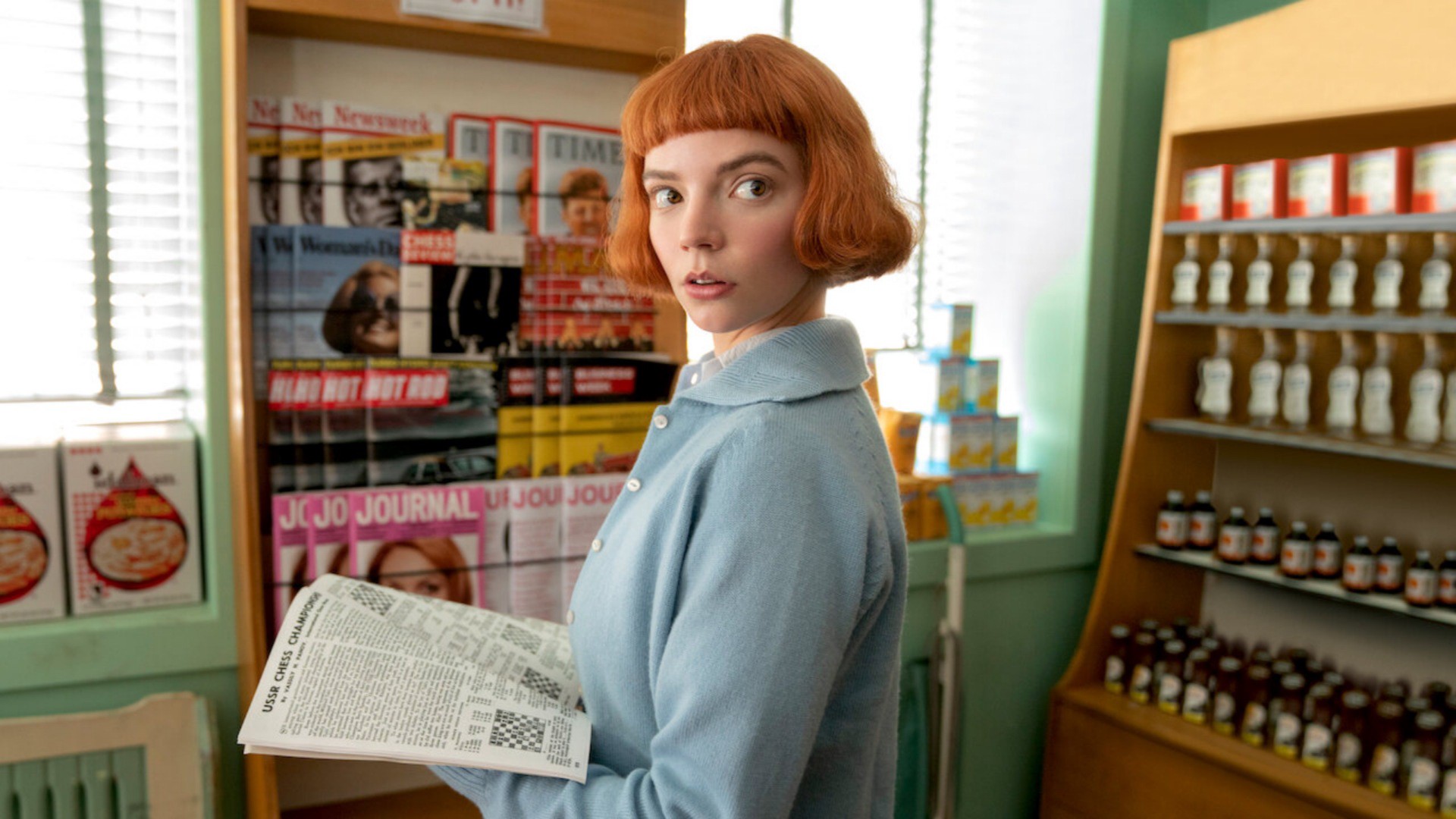 The Queen’s Gambit (Netflix)
The Boys (Season 2) – Eric Kripke (Prime Video)
I don’t think this season of The Boys is fundamentally different from Season 1 so it’s a bit strange to find myself feeling much less enthused about it. I think there are a number of factors playing into this. Gioia and I binged the first season and, strangely, I just think this show is conducive to that style. I wonder if that has more to do with my general taste than anything else? On paper, this show shouldn’t work for me at all. I’m not a comic book or superhero person. I don’t love excessively violent or graphic art. I am not a fan of the glib, nihilistic tone of this series. And yet, I do like it! I think generally there’s enough heart and personality to the characters to pull me through. I guess what I’m wondering is whether the aspects of the show that I don’t like begin to fade when binge-watching the series? Whether binge-watching the show allows me to move past these aspects and appreciate the more nuanced and subtle qualities of the series that I do like? That’s one theory. The other theory I have for Season 2 is that I don’t feel like the show is developing in any interesting or particularly meaningful way. It’s getting stale. One of the things that I initially loved about this series is that it was a meta-commentary on superhero culture. And I think it still is. But after two seasons, you begin to realize that a meta-commentary isn’t very far apart from the thing it’s poking fun at. So whether or not it’s smart or clever, The Boys in a lot of ways is still a superhero show. What does this mean? Will I watch Season 3? Probably. The Boys is still well-written, directed, acted, etc. And frankly, that’s not a baseline most other shows even hit. But, I am also realizing that I don’t think this show will ever climb above a B or B+ for me. Hopefully it proves me wrong.
The Jinx: The Life and Deaths of Robert Durst – Andrew Jarecki, Marc Smerling, Zac Stuart-Pointer (HBO)*
I thought this series was flat-out incredible when it came out. I have to say that re-watching it, my admiration has only grown. There has been a tidal wave of true crime media in the five years since this originally aired. And that’s probably a good thing! There have undoubtedly been more voices, experiences, and types of stories told because true crime is such a popular genre. One of the topics they touch on in I’ll Be Gone in the Dark is that this is a media form that is extremely popular with women. That’s obviously great! On the flip side, this wave of true crime has also led to a lot of bad material. Just this year alone, I’ve watched Tiger King, Atlanta’s Missing and Murdered, and The Vow. These are not good documentaries. I think their subjects are, more or less, all worthy of coverage. But the execution in these projects is lacking to say the least. Tiger King is so overly-sensationalist there’s no feeling to it. Atlanta’s Missing and Murdered doesn’t have anything interesting to say, or even to ask. And The Vow is a 2-hour story in which (as I write this) we are somehow at hour 9. It’s brutal! And to be fair, when you look at The Jinx objectively, you have to note that a lot of its success comes down to sheer luck. How many of these true crime documentaries actually find the piece of evidence that catches their subjects? How many of them get their subjects to confess on tape? Andrew Jarecki and his team obviously put themselves in those positions, but come on. These are acts of God! But even aside from these revelations, Jarecki and his team do everything right. This story, which comprises three murders, multiple identity changes, a trial, a damning piece of evidence, and a freaking confession lasts a total of 4.5 hours. Not bad. And Jarecki and his team are never afraid of confronting Durst. They ask tough questions even as they know the last person to hold evidence against Durst was murdered by him! Finally, I have to say that the tone of the series is perfect. This is a wild case. Durst is undoubtedly charismatic. As a result the series is often funny. How could it not be? But it also never forgets that the subject is about three murdered women. What an achievement. If only true crime could get back to this standard.
*Aired 2015
Schitt’s Creek (Season 6) – Dan Levy, Eugene Levy (POP)
I’m going to keep this post brief. Everything I could say about this season is in-line with my thoughts about the first five seasons. Schitt’s Creek is wonderful. I rarely think it’s the best, funniest, or most inventive show. But it’s always very good. Sometimes that’s all you need.
The Vow – Jehane Noujaim, Karim Amer (HBO)
This just got renewed for a second season. I can’t believe it. As I’ve mentioned elsewhere, this documentary is absurdly long. Having finished it the first season, I can also say that it is infuriatingly aimless. So what went wrong? I think there are (at least) three obvious things.
1. The greatest strength of this documentary is the amount of footage they have. Which, alas, is not because of any great foresight on the part of the documentarians, but because one of the members, Mark Vicente, was a filmmaker who was prompted by Keith Raniere to film NXIVM’s every move. Luckily, he also applied this thinking in his time leaving NXIVM. Unfortunately, this also means that this documentary started being made before they even knew what they had. This season lasts for 9 (9!) hours and doesn’t even touch on some basic things I knew about the company from reading The New York Times. How can that happen? Think about some other recent true-crime series. I’ll Be Gone in the Dark covers a serial killer whose attacks stretched over three decades, as well as the tragic death of the writer who worked to solve the case, all in the span of six hours. The Jinx is just about the craziest shit I have ever seen and wraps up in under five hours. The Vow’s premise could probably make a decent 90 minute movie. So far it has lasted 9 hours and still has left major things out. Obviously, the plan at some point became to address these missing pieces in Season 2. I’m skeptical that it will work.
2. Again, this documentary crew does not know what they have. As I just said, this appears to be literally true in that the case was unfolding while they were making it. (Really, why not just wait a year to make this?) Still, I really don’t think these filmmakers know what they find so interesting, disturbing, inspiring, enlightening, etc. about Keith Raniere, NXIUM, or the victims. To some extent, the show’s arc does make sense. They begin by showing the promise and allure of the company, peel that veneer away, and finish by revealing the most disturbing parts of it. But the show doesn’t even know what it finds interesting on an episode to episode basis. The revelations of this documentary feel like they were placed in a hat and pulled out at random. The show’s final episode, for instance, gives equal to time to the fact that Keith once made one of his victims eat dirt from a puddle as it does to the fact that he made people re-shoot parts of a promotional video after he cut his hair. Never mind that the show’s final hour pays no mind to the actual sex trafficking that Raniere and his company were engaged in and ultimately prosecuted for.
3. The filmmaking in this documentary is really bad. I would much rather focus on the contents of the documentary itself. Honestly, this is the type of documentary in which the filmmakers shouldn’t even be noticed. But almost every production detail of this show is distracting. This extends from the grating music queues, to the awful re-creation graphics, down to the victim interviews. And these details detract from the series’ potential as much as its meandering focus, absent details, or even nine-hour run time. On top of all that, I can’t think of an end of any documentary as bad as this one. We have a montage comprised mostly of scenes from the opening credits set to a remix of the awful theme song. Then, the Season 2 teaser: after spending nine hours dissecting what a manipulative, sociopathic liar Keith Raniere is, we end with the promise to hear his side of the story. It’s almost offensively bad. I can’t believe I watched it. I can’t believe I’ll probably watch Season 2.
The Third Day – Felix Barrett, Dennis Kelly (HBO)
The Third Day has a major Lost problem. And no, it’s not that they’re both shows centered on strange, magical islands. Well, maybe it’s that a little bit. But Lost‘s biggest problem was that it was centered on questions that were ultimately unanswerable. Somewhat ironically, that is exactly what made the show so unbelievably good to begin with. The questions the show asked, and the mysteries it presented, were mind-boggling. It made for thrilling television. How could you not keep watching? Once the show had to answer these questions, well, it wasn’t so good. But Lost at least gave us dozens of hours of thrilling, poignant, and deeply satisfying television. It had a tremendous amount of time to invest in characters, themes, and even storylines that were all enormously successful, even if the central mystery was not.
To me, this is really the issue with The Third Day. Like Lost, this show began as a mystery so puzzling and idiosyncratic, it was extremely exciting. I hadn’t seen anything like it on TV. And while I certainly enjoyed the first 3-4 episodes, more than anything I was thrilled at the prospect of how it would come together. And unfortunately, like Lost, it doesn’t. But for this show, that’s an even bigger sin and perhaps one it can’t overcome. The Third Day is six hours total. Because of that, there’s no time for any of the things that redeemed Lost: heartfelt characters, successful side-quests and storylines, or even humor. At least it had Jude Law.
The Queen’s Gambit – Scott Frank, Alan Scott (Netflix)
This show is good. Perhaps even great. I’m going to state that up front. One, because it’s a show about chess. Not something I would have guessed could be so riveting. And two, the largest conversation I’ve seen about this show is whether or not it should have been a movie. It’s hard for me to say. I love TV. I don’t think there’s anything better than having a show you can’t wait to watch. And for one week for me, that was The Queen’s Gambit. So why would I complain that this should have been a movie? Well, it definitely declines in quality as the show goes on. I think the drop off is really when Alma dies, about half-way through. And it’s not specifically that anything about the show gets worse. It’s that it is doing the same thing over and over again: Beth trains with a former opponent, they sleep together, she sabotages herself with pills and booze, she struggles to get sober. And it’s not that this doesn’t work. It’s really classic sports movie stuff (with chess being the sport in this scenario). But it just happens over and over again. So I really don’t know. I think if you removed all of the filler from this show, it’s still about 3-4 hours. Admittedly, that’s less than 7, but I’m not so sure I would have watched a 4 hour movie about chess wither. I guess I’m glad this was a show. If its worst problem is that it drags on, so be it.
November
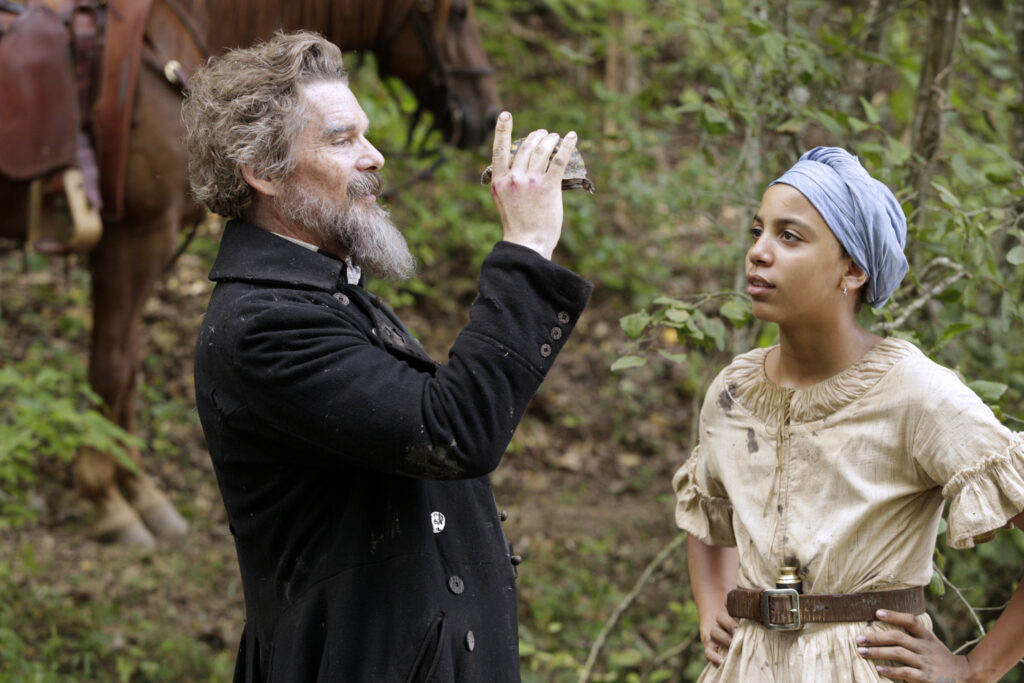
The Good Lord Bird (Showtime)
The Good Lord Bird – Ethan Hawke, Mark Richard (Showtime)
I’m not sure that The Good Lord Bird is necessarily the best series of the year. I think I May Destroy You is still probably the show to beat. But even if this is only the 2nd or 3rd best show of the year, it is certainly the one I enjoyed the most. I don’t know if there’s bigger Ethan Hawke fan than me, and I’m even in awe of his performance here. Sure, it is an extremely showy one. It’s the type of performance that’d be guaranteed to win an Oscar if this were a movie. But one, this is a magnificent performance, showy or not. And two, Ethan Hawke’s previous best work had come largely from roles in which he’s playing a version of himself. This is a departure, and not one that I knew he had in him. But for as great as his performance is, I think what’s most impressive about Hawke’s work is his stewardship of this story. The Good Lord Bird is, in concept, a white man telling a Black story adapted from a novel by a Black man. It could have gone disastrously. But Hawke smartly puts himself, and white perspectives, on the back burner as much as possible. I’ll have to see when I read the novel, but I’d guess that Hawke was as deferential to the source material as possible. This is a story about John Brown. But it’s a story about John Brown from the perspective of a freed Black slave. That Hawke knows the difference between these approaches (or again, just followed the novel) makes this series what it is. The ultimate example of this is the ending, which is incredibly moving. But you’re not moved by John Brown, or his execution. You’re moved because the last episode, in particular, does a beautiful job at portraying what the world is like for Onion and other Black men and women at this time. If you’re moved by Brown, it’s in his anger and incredulousness at the institution of slavery. There’s a reason the show ends with the faces of its Black characters, not Brown’s. The beginning of each episode of this series had the tag, “All of this is true. Most of it happened.” I can’t think of a better way to put it then that. This show was able to capture an essential truth about America’s history. That’s quite an achievement.
The Great British Baking Show (Series 11) -Anna Beattie (Channel 4 / Netflix)
I thought this was a pretty mediocre season. The bakers seemed to be fairly middling compared to past contestants. And I think that the final three may be my least favorite in series. Still, even in a down year The Bake Off is the most comforting show on television. For ten weeks it was the best way to start my weekend. I’ll miss it.
Industry – Mickey Down, Konrad Kay (HBO)
This is the most enigmatic show I’ve watched since Succession. Sorry to do that up front, but it’s a comparison that’s going to come up a bunch. What I mean by that, specifically, is that down to each individual storyline I had no idea what was going to happen. I’m sure 75% of that is the business of it all. Honestly, I would say it’s even more veiled here than in Succession. The show is really trying to capture how it would feel to be on the floor of a bank like this. It’s not going to slow down or translate what any of this business means. You have to catch up. And that’s a huge plus. It is probably the show’s greatest strength. Besides Succession, which again is the greatest show on right now, I don’t think there’s another show that is so committed to its world and its story. As frustrating as many things can be in the “post peak-tv” era, it’s hard for me to imagine shows like Industry existing beforehand. Even a series like Mad Men had to translate some business and 60s lingo for the viewer. So is this show the successor to Succession (sorry)? Not yet. I will absolutely watch Season 2. Overall, I did like it. It’ll probably wind up in my top ten shows of the year. Still, I thought the last half of the season was a bit of a letdown compared to the first. Which makes sense with what I’m saying. If the show’s greatest strength was setting up this world, it makes sense that it slips in the execution after that. I will say too, one of the issues I have with the show may just be an issue on my end. It’s simply that I found all of the characters to be unlikable. And this is fundamentally different than say, Succession in which I find all the characters to be despicable, but I still like them quite a bit. But given that everything else about Industry seems accurate to its world, perhaps it makes sense that I don’t like these characters. I certainly wouldn’t like them in real life.
December
 How to with John Wilson (HBO)
How To with John Wilson – John Wilson (HBO)
This is my favorite show of the year. It’s creative, completely unique, and really just the perfect blend of weirdness, comedy, and compassion. It made me feel almost exactly how some of my favorite films do. It’s so entertaining and seemingly irreverent, but also kind of profound. I think by far the most impressive part of the series is how it was made. The entire show is comprised of footage shot by one person, the titular John Wilson, that he narrates over. And somehow, he’s able to use this footage, and this ambling narration, to make a coherent story. It’s remarkable! I literally don’t know how he did it. My only guess is that he has meticulous labels for everything that he films and spent years assembling them into the perfect story. But this obviously can’t be entirely true! The last episode deals with COVID-19, making the footage (at most) 9 months old. And not only was this episode a highlight in the series, I think it’s the best COVID-related material I’ve seen. I don’t know if there’s been another film or tv show that has captured this moment so well. I’m fascinated to see what it’ll be like to watch this episode in 5 or even 10 years. But for now, this was the perfect show to watch in this moment. I really needed it.
Murder on Middle Beach – Madison Hamburg (HBO)
I was quite skeptical of watching this after my experience with HBO’s other true crime docs this year. There was I’ll Be Gone in the Dark which overall was well-done but scared the absolute shit out of me. Then there were Atlanta’s Missing and Murdered and The Vow which were not only bad, but excruciatingly long-winded. Luckily, Murder on Middle Beach strikes the perfect balance, at least to me. Given how broad the true crime genre is, there are certainly different aspects and approaches that appeal to different people. But in terms of what I want out of a series like this, Murder on Middle Beach ticks all the boxes.
According to my brother, Madison Hamburg has said that Minding the Gap was a big influence in how he approached this project. And I think that’s really telling (though I should say that Hamburg had been working on this project for over 5 years before Minding the Gap came out). But what I admired most about Minding the Gap was how Bing Liu focused so closely on the lives of his friends in order to tell a larger story. At it’s core, the film is really just telling a story about Liu’s, and his friends’, experience with abuse. But because Liu is able to tell this so truthfully, and with so much care, the film becomes universal. It touches on issues of race, skateboarding, friendship, and the collapse of the industrial Midwest in ways that feel more honest than if he set out to make those subjects his primary focus.
In Murder on Middle Beach, Hamburg sets out to tell the story of his mother’s murder. And the series is certainly focused on that. I don’t mean to say that this isn’t the central question of the documentary. But a frustration I have with most true crime is that often in exploring its case, the project loses track of the humanity involved. To some extent, I think that started to happen with I’ll Be Gone in the Dark. I think where Hamburg differs is that his series prioritizes the human toll of this murder over the whodunnit of it all. So while this series is about finding who killed his mother, it also explores family dynamics, trauma, secrets, alcoholism, and grief in ways that feel startlingly honest. And in fact, Hamburg turns his focus to these subjects in the last hour of this series. The climax is not a major revelation about the case, but rather, an address about the ways this murder has divided his family. It’s a beautiful decision and one that I think will make this documentary stand the test of time.

 Sam Writes Shit
4 thoughts on “2020 Television Log Part 2”