

1st: A Brighter Summer Day – Edward Yang (1991)
I’ve already said so much about this film but in all honesty it has so completely altered my idea of what movies and art can be that I want to keep trying to capture it.
In this most recent screening, I gravitated to Yang’s focus on tangible items: a flashlight, a lightbulb, a watch. He’s able to pull off an astounding feat in which he elicits grand emotions from largely stationary and relatively muted shots (often focused on one of these simple objects or a rather ordinary act). I’m thinking specifically about the sequence in which Xio Si’r’s mother discovers her husband eating at Uncle Fat’s shop. Though nothing quote unquote happens, the shot is unforgettable in the way it portrays emotional devastation.
To me, that’s the way these profound moments actually occur in life. Don’t get me wrong, I love films with high drama and two actors screaming at each other, but sometimes the “theatrical” gets in the way of portraying an authentic “truth.” Yang’s work instead recalls the way that these profound moments occur in real life, what Joyce tried to capture in his “epiphanies” or Virginia Woolf in her “moments of being.”
Grade: A
1st: Terrorizers – Edward Yang (1986)
Starting from “A Brighter Summer Day,” Yang’s later work, across different tones and different settings, all capture or comment on the random and occasionally profound intersection of human lives. His first two films, “That Day, on the Beach” and “Taipei Story,” while fully-realized, feel like blueprints for the emotional aspect of his work: How people can feel lonely in a city, etc. “Terrorizers,” by contrast, feels like a first attempt at creating a story full of intersecting storylines where maybe the emotional payoff isn’t quite there, but is still a very well-made project.
Grade: B+
2nd: Yi Yi – Edward Yang (2000)
In one of the most lyrical and meditative films of all time, we can’t rule out that one of the passages might center on Star Wars Episode 1 being too serious
Grade: A
3rd: Taipei Story – Edward Yang (1985)
My 1000th review! Visually, one of the most beautiful movies you’ll ever see. The story is maybe not quite as polished as Yang’s later work. It’s slower, a little more raw. But I think that also serves the film in some ways. So it’s already great. And then there’s a ten minute stretch starting at the birthday party that is maybe my favorite piece of filmmaking ever. Feeling very blessed by this retrospective. Thank you, film center. Thank you, Edward Yang ❤
Grade: A-
5th: Mahjong – Edward Yang (1996)
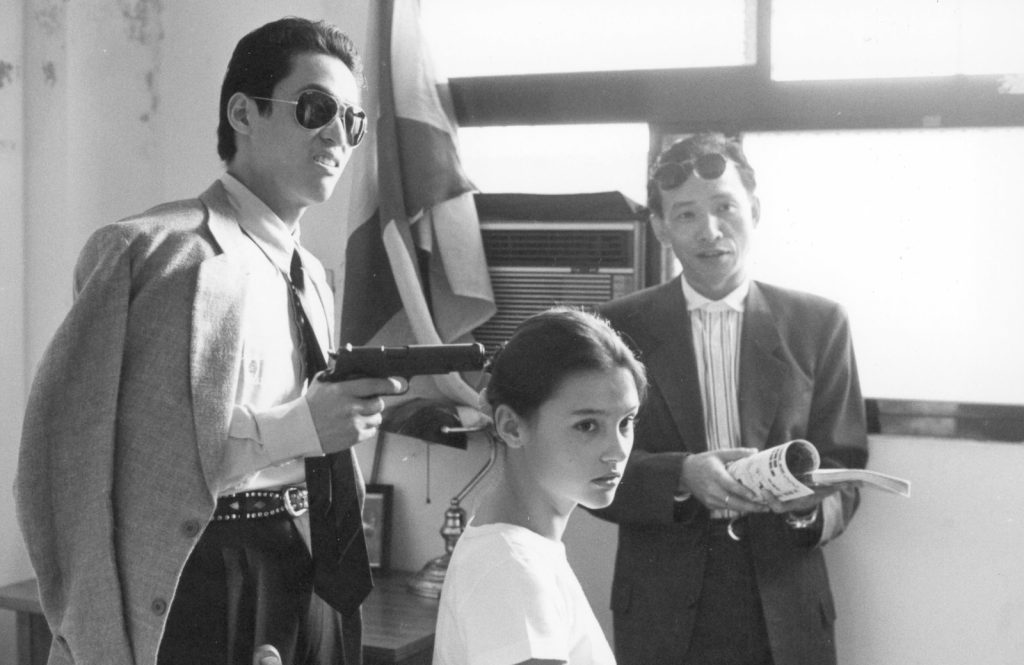
I can’t believe this had been so hard to see in America until now. It’s so good and becomes funnier and funnier in ways that I never expected (see Chang Chen’s storyline). Speaking of Chang Chen, who is Virginie Ledoyen? How could a film with such beautiful people not be available? Crazy!
Grade: A-
5th: A Confucian Confusion – Edward Yang (1994)
Before this 4k restoration I watched this movie via a youtube rip that must have been in 240p and had subtitles that moved too fast for me to read. I was nervous that this, perhaps, was a Yang film that I did not like. Turns out that being able to see and understand the dialogue of a film goes a long way. This is pretty good and while a bit long, kind of gets better and better as the movie goes on.
Grade: B+
6th: In Our Time – Edward Yang, Chang Yi, Ko I-Chen, Jim Tao (1982)
Absolutely delightful. Main question: How did Yang get around paying the Beatles millions to use their music?
Grade: B+
7th: A Brighter Summer Day – Edward Yang (1991)
I think I’ve gone to more Edward Yang screenings this week than I went to total movies last year and at no point did someone yell out, “Has anybody been to Taipei recently? Did you take pictures of the film locations?” Alas, maybe next retrospective. A boy can dream…
Grade: A
12th: The Godfather – Francis Ford Coppola (1972)
What can you say about The Godfather that hasn’t been said already? Just a near-perfect movie that’s even more remarkable for its vast appeal. In a world in which the difference between film as a piece of art and film as content/entertainment feels completely unreconcilable, it’s amazing to see something made 50 years ago that got that balance exactly right.
On a side note, I hadn’t watched this since I was a kid and either through its impression on me or its frequent references throughout tv and film, I pretty much remembered everything…except for Apollonia? I’m assuming my feeble 12-year old mind must have just blacked out when I saw her.
Grade: A
14th: Blow Out – Brian De Palma (1981)
An absolute banger. So glad I got to see this on the big screen. Travolta is legitimately so captivating in this. Loved the conspiracy/political angle. The liberty parade sequence reminded me a lot of Pakula’s “Parallax View.” Come to think of it, the serial killer plotline here isn’t that dissimilar from Pakula’s “Klute.”
Grade: A-
15th: Saturday Night Fever – John Badham (1977)
I never in a million years could have guessed how dark this movie gets. And with that, I’m not sure I can say I quite “liked” the film. I’m not opposed to its bleak tone or plot, but those sequences so often feel unnecessarily cruel and raw. Still, I must admit that much of the film is undeniable. The disco sequences especially are just immaculately performed and shot.
Grade: B
19th: The Zone of Interest – Jonathan Glazer (2023)
Haven’t been this torn on a film in a long time. Let’s try to unpack.
Pros: It’s visually stunning, immaculately performed, and viscerally unsettling. It’s been a while since a film has left me so uneasy (which is exactly what I’d want given the subject matter). From a technical standpoint and from an ambition standpoint, this ranks at the top of 2023 for me.
Con(s): Am I positive what the film is saying is clear and focused? And for the record, having clear intent is not irreconcilable with that intent being complicated/unsettling. Again, from a technical aspect, I love the structure of the film. The box that we stay in as an audience is fascinating and evocative. In terms of eliciting emotion, being able to only hear the horrors, and not see them, is truly frightening. And yet, I’m increasingly thinking this division is not right for this story.
This film, to me anyways, centers on the agnosticism and banality of space. That a place can serve unimaginable evil (Auschwitz), willful ignorance and hate (the house), acts of mercy (the neighbor) and acts of service (the museum) solely on the basis of the people that occupy it.
So yes, because we have Hedwig’s and the children’s POVs, keeping them and the audience outside of the death camp makes sense. It reflects the reality of their life which is profoundly disturbing.
But here’s the problem. We’re not only watching this film from their POVs, but Rudolf’s as well. And not only is he well aware of what is happening next door, he’s the perpetrator! And so, for the film to remain outside of the camp and the horrors all while he is the primary executor of them…I don’t know. It makes me question whether the structure of the film is in service to this story or a contrivance in service to Glazer’s interests as a filmmaker?
Which is not an easy realization to arrive at! I honestly don’t think this film is made with bad intent. Glazer is clearly an extremely gifted filmmaker. I generally like art that takes big swings and in this film, Glazer gives us a new and horrifying perspective of a piece of history that has been documented and dramatized to no end.
But making a film about any piece of history and especially the Holocaust is extremely complicated. And if someone were to say they were making a film about Auschwitz in which they weren’t going to show the actual camp, the victims, or any of the deaths (which is what this film essentially is, albeit with technical brilliance), I just don’t know if I’m ever going to get behind that.
Grade: C
21st: The Assassin – Hou Hsiao-Hsien (2015)
One of the most beautifully shot films I’ve ever seen. There are a handful of compositions that are just mind blowing. As for the story, I need some time to sit on it. There’s a strange dichotomy between the film being so visually meditative and the plot being so action-driven. Not saying it doesn’t work, it’s just a bit jarring, especially compared with the earlier Hsiao-Hsien films I’ve seen. I think there may also be a personal disconnect for me with the story. It’s based on 17th-Century Martial Arts story that I was not familiar with it. I love that Hsiao-Hsien doesn’t spend many details on the intricacies of the plot or story, but again, for a someone like me, it makes the story feel impressionistic. Which is not a bad thing, just a bit unusual for an action film.
Grade: B
26th: Godland – Hlynur Pálmason (2022)
I really wanted (and expected) to love this film. I love the premise, I was incredibly excited to see these landscapes. And yet, sadly, it doesn’t totally work for me. For anybody curious, it’s certainly worth seeing based on the photography and cinematography alone. That being said, I found most other elements of the film to fall flat. I’m not sure the story has much to say that hasn’t been documented in other projects. Or certainly enough to justify its runtime.
Grade: C+
29th: The Godfather: Part II – Francis Ford Coppola (1974)
The only thing I can think to write is some long-winded explanation about why I think Godfather I is ever so slightly better than Godfather II. But like why split hairs over two of the biggest and best films ever. And so I’ll leave with an even sillier splitting hairs-type question: Is this the best Pacino performance ever?
Grade: A

 Sam Writes Shit
One thought on “2024 Movie Log: January”