

2nd: The Wolfpack – Crystal Moselle (2015)
This documentary was billed as the story of an eccentric group of brothers who reenact movie scenes as a way of engaging with the outside world. And while that is certainly part of it, I think it undercuts the real subject that Moselle is exploring. While this doc does highlight the Angulos’ fanatical love of movies, it focuses most closely on the circumstances of this family’s upbringing. Maybe it’s a given, but we quickly learn that those circumstances have been pretty dark. It’s not what I was expecting from the clips I had seen of these brothers recreating scenes from Pulp Fiction and Batman. I do think the film is much better for Moselle’s approach to this story. It’s hard to really assess this documentary as a piece of filmmaking separate from its subject. With no disrespect to Moselle or anyone who worked on the film, most of what works about the movie is this family. You get both the horror of the abuse they suffered, and also the humanity that shines through as they tell their story. They’re funny, charming, completely unique, and just bursting with life. It’s a real thrill to watch as they slowly explore the world outside of their apartment.
Grade: B
6th: Varda by Agnès – Agnès Varda (2019)
The start of my dive into Agnès Varda! I loved this film. It’s like the greatest TED Talk ever. It’s really as good an introduction as you could have for a filmmaker. On one level, this film is a staged lecture of Varda discussing her career and her work. On a second level, this lecture (and film) is also actively being made by Varda. It’s a documentary with her as both the viewer and the subject. Finally, the film is interspersed with moments of cinematic flourish and recreation. Varda interviews former collaborators. She recreates scenes from her films. You learn who she is both by what she is telling you and how she is telling it to you. Incroyable!
Grade: A-
7th: La Pointe Courte – Agnès Varda (1955)
According to the Criterion’s companion booklet, Varda had only seen ten films in her life when she decided to make La Pointe Courte. What in the actual hell? It’s not like this film is even some weird, half-baked, first try either. It’s great! There are shots in this this film that feel like a precursor to Ingmar Bergman’s Persona. There are moments that resemble a Mike Leigh film. One of the central plots is a direct forbearer to the Before Trilogy. Now, to be clear, it’s not like Varda was coming out of nowhere. She was already an established photographer. For as much as I like all aspects of the film, I would say the shots and compositions are the standout feature. Plus, Varda had Alain Resnais edit the film together. So there was obviously an abundance of talent behind this film. Perhaps it’s fitting that Varda went into this movie with little formal film knowledge? Like the rest of her career, she’s able to blend genres and styles here in a way that’s completely her own.
Grade: B+
10th: Molly’s Game – Aaron Sorkin (2017)
I was hoping this movie was going to be good. I like Aaron Sorkin. I like a lot of the actors. Poker movies are generally pretty fun. Although I remember it getting mixed reviews, it does seem to have found a second life. On top of that, I liked Sorkin’s most recent movie, Trial of the Chicago 7, which also got mixed reviews. Unfortunately, Molly’s Game doesn’t have the same luck (or skill if we’re talking poker). It’s pretty rough all around. The plotting and stakes are off, Jessica Chastain’s Molly isn’t likable or sympathetic, and Sorkin keeps pushing some type of morality onto this movie that I don’t think really exists. To be fair, there are a couple of vintage Sorkin exchanges but it’s really the only thing that saves it from being a total disaster.
Grade: C-
Molly’s Game – Aaron Sorkin (2017)
11th: Coming to America – John Landis (1988)
This is the hardest I’ve laughed in a long time. I have to be honest, I was kind of nervous about this movie. I know it’s a classic, but a lot of the other classic National Lampoon / SNL styled comedies have not aged that well. Plus, this one’s about a fictional African prince. Now, I know I’m the last person who should examine the political correctness of this movie, but if anybody’s curious, I thought it held up incredibly well. And from just a comedy standpoint, this movie is fucking hilarious. I was cackling throughout the first half it. The 2nd half is still good, but much less funny. That’s generally the way it goes for comedies.
Grade: A-
Coming to America – John Landis (1988)
12th: David Byrne’s American Utopia – Spike Lee (2020)
It’s a bold move to make a concert film when you’ve already made the best concert film in history. Especially considering that Byrne uses many of the same songs as he did in Stop Making Sense. Fortunately, these songs are some of the best ever written and they easily hold up in another iteration. Across the board, I thought this concert was unbelievable. I love the songs, the band sounds amazing, and the choreography is incredibly compelling. I even thought Byrne’s spoken passages and the general themes of the show were moving. There are one or two lulls, stretches in which you wait for the next Talking Heads greatest hit. But really, I thought this was the best concert film I’ve seen in a while. Which is where I’ll say that Spike Lee does an amazing job filming this. I loved the way he cuts to perspectives in the audience. I love how he frames so many shots so you can see people dancing in the crowd. I was honestly kind of shocked by how dynamic the filming is. He circles the stage and weaves between the performers. It’s striking but perfectly complements this performance.
Grade: B+
13th: Paris is Burning – Jennie Livingston (1990)
I can’t think of another film in which so much of the impact has to do with what’s not on screen. Just taking in what we see, there is an enormous amount to digest. This film sets out to profile the ball and house culture of 1980s Harlem. But from this focus, Livingston is able to touch on aspects of trans and queer culture, race and racism, homophobia, the widening class discrepancy of the 1980s, and eventually, the looming AIDS crisis. Incredibly, she does all of this in just 75 minutes. In just what’s presented on screen, the aspect that stands out most are the people. We meet the most prominent figures of this movement, all of whom are incredibly charming, funny, and witty. They share their greatest aspirations and stories of their struggles. There are a couple instances in which we see them attain the success they dream of. Willi Ninja, for instance, becomes a prominent dancer and choreographer. More often, we don’t see these successes. In the most devastating sequence of the film, we learn of the unsolved murder of one of the subjects, Venus Xtravaganza. But what my mind keeps returning to is what Livingston doesn’t capture in this film. Mainly, the AIDS crisis which eventually kills most of the film’s subjects. In many ways, it completely changes the meaning and impact of the movie. It’s one thing to hear the hopes and dreams of these people. It’s another to hear them all while knowing that many will die in the next few years. I don’t mean this in a general way either. Many, if not most, of the film’s subjects did die over the following few years. Moreover, some of the subjects in this film were unhappy with Livingston and the film in general. There are certainly complicated identity politics happening in the making of this movie. Livingston is a white person making a documentary about an almost entirely Black group of people. As you can tell, this is going to take me a while to process. Still, I thought it was an incredibly impactful piece of filmmaking.
Grade: B+
14th: Let the Sunshine In – Claire Denis (2017)
This film explores a subject I’ve never really seen on-screen. It follows Isabelle as she navigates dating, sex, and love as a recently divorced, middle-aged person. I really admire how biting Denis is in this film. It’s one of the most unflattering movies I’ve ever seen. I don’t think anyone comes away looking good in it. That applies to Juliette Binoche’s Isabelle as much any one. Binoche is obviously an extraordinary actor and is able to garner some sympathy for the character through her performance. But it’s not much. For me, this is where the movie falls a bit flat. It’s so cutting, it’s hard to feel that much besides relief when it’s over.
Grade: B-
Let the Sunshine In – Claire Denis (2017)
15th: Crip Camp – James Lebrecht, Nicole Newnham (2020)
This is easily the most moved I’ve been by a movie in some time. I was on the verge of tears throughout. What is remarkable about it is that it’s not played for this type of sympathy. There are no cheap tricks or attempts to engineer a wave of emotion from the audience. In fact, it’s quite the opposite. This documentary highlights the landmark achievements made by disability advocacy groups and specifically those that emerged from Camp Jened. The reason I was moved by the film is because it is so overwhelmingly affirmational. We get a portrait of this camp, of a world in which these people are finally allowed to just be themselves. It’s moving because in watching it, you see just how much has been taken away from them. It makes you furious as you watch them have to fight so hard and for so long for what should already be theirs. Something that I really admired about the film is the way it subtly lays out how to carry out a successful movement. We see these people come together at camp and realize how the world should be. They then go out to advocate for this policy. They find a bill in which to include it. Once it’s passed, they then have to advocate for the government to enforce it. I am by no way endorsing the cruel system through which they have to navigate. But it does lay out a blueprint of how to carry out action in our fucked-up society.
Grade: B+
16th: Sound of Metal – Darius Marder (2020)
I wasn’t sure how I felt about this movie for most of its run time. As a baseline, I thought it was well-made and that the performances were great. And to my limited knowledge, it seems to handle deafness and disability in a thoughtful and considerate way. I really liked the first half of the film. I thought the sequence in which Ruben first loses his hearing was particularly amazing. I loved seeing the actual process of him and Lou trying to figure out what to do. I also loved that this film skips the part in which Ruben struggles to fit into the rehab community. For a moment, I thought that was going to be the main tension of the film. But suddenly the film fast-forwards and we see Ruben thriving. The problem with the movie for me is after this moment. As soon as Ruben contacts the doctor’s office, you more or less know what will happen the rest of the film. Which is a shame because the first part of the movie felt so unpredictable. This is all probably coming off as more negative than I intend. I just thought this movie was going to be great. At the end of the day, it’s pretty good.
Grade: B
Sound of Metal – Darius Marder (2020)
20th: The Muppet Movie – James Frawley (1979)
I know that The Muppets weren’t made just for kids. Still, I feel a little strange reviewing something that is certainly aimed toward children. There are many things I love and admire about this film (and The Muppets in general). The jokes are incredible. I am particularly fond of Fozzie’s magnificent introduction, “Here I am, Fozzie Bear, to tell you jokes both old and rare. Wocka Wocka Wocka!” The characters are obviously endearing. I love all the cameos. I certainly did not realize or remember Orson Welles’s role in this film. Not to mention that this film features an unbelievable soundtrack. It’s amazing that “Rainbow Connection” became a legit hit song! Still, my point remains that anything I can say about the movie now is much less meaningful than what I would have said as a kid. Luckily, my impression of the movie is about the same as it was when I was 10: I loved it.
Grade: B+
Muppet Movie, The – James Frawley (1979)
21st: Tangerine – Sean Baker (2015)
Surprisingly enough, I first saw Tangerine in film school. Who knows, if more of the curriculum had been based around films like it, I might have stayed. Sean Baker is one of the most interesting filmmakers working. He makes films whose settings and characters are determined by real life. In keeping with that approach, he even casts many non-actors in his films. Watching the movie last night, I was struck by how fine a line he is walking. In this instance, he’s a white man making a film about two Black, trans, sex workers. And although I’m not the person to make this determination, I don’t think the film is exploitative. That all comes down to the portrayal of its main characters, Sin-Dee and Alexandra. It’s not that Baker focuses on two people who are rarely seen in the movies that works, it’s that these characters have life and personality beyond any stock characteristics. They feel like dynamic, real people. Which is where I’ll say that beyond all the big things that make this film interesting (the plot, setting, and characters), the success of it really boils down to the small things. It’s well-written, features amazing performances, and (if you can get past the iPhone of it all) looks pretty good too.
Grade: B+
Tangerine – Sean Baker (2015)
22nd: American Factory – Julia Reichert, Steven Bognar (2019)
I’m amazed that this documentary was made. I still can’t believe the access and (seeming) transparency Reichert and Bognar got to Fuyao. It’s really something to watch as these American and Chinese workers struggle to come together. It’s stunning when we how the executives at Fuyao are dictating the terms of this relationship. Overall, I think this documentary is fascinating. I agree with most of its politics. Yet, there’s something that makes me leery of it. Perhaps I’m just suspicious that Reichert and Bognar could get this type of unfiltered access to Fuyao? Perhaps I’m wary of the Obamas’ role in this film? There’s nothing I can point to and say “this was done wrong.” Still, I have a bit of unease about something in this movie. It’s probably just the robots.
Grade: B-
23rd: Free Solo – Elizabeth Chai Vasarhelyi, Jimmy Chin (2018)
I am almost certain that I will never watch this film again. The final stretch of it, in which Alex Honnold does a free solo climb of El Capitan, is some of the most stressful filmmaking I’ve ever seen. I loved how the film kept cutting back to the cameraperson’s own reaction as it was happening. Honestly, I’m surprised by how much I liked this documentary. I expected it to have breathtaking footage. I knew that watching someone do a free solo climb would be incredibly dramatic. Still, I’m not sure I expected everything else to be done so well. I particularly liked how the filmmakers inserted themselves into the movie. We watch as they discuss their own relationship with Alex, the effect that filming him during a climb could have, and especially how they’re preparing for a worst-case scenario in which Alex falls and dies. I think this film is a really interesting exploration of mortality. I’d love to read or see more about the ethics in making something like this.
Grade: B+
23rd: The Great Muppet Caper – Jim Henson (1981)
I would say that across the board this is a step down from The Muppet Movie. The jokes aren’t as sharp and the songs aren’t as good. Still, it’s pretty entertaining to watch. I love the Hollywood spectacle Henson brings to it. It’s fun watching these muppets navigate a film of big sets, stages, musical numbers, etc.
Grade: B-
24th: Another Round – Thomas Vinterberg (2020)
In the wrong hands, this movie could have been pretty bad. The premise is so broad that you can almost see the terrible American version of this movie. Luckily, this film is pretty wonderful. What I think really works about it, is that Vinterberg sticks out his premise to its logical conclusion. In the aforementioned (not yet existent) American version, we would probably have the same set up: four middle-aged colleagues and friends take up continuous drinking as a social experiment. From there, however, I’d imagine the film would devolve into wild, drunken shenanigans. Vinterberg, instead, takes this premise and tries to play out what would actually happen. It’s wonderful to watch as Martin and this group succeed with their experiment at first. We watch with horror as they continue to up the dosage. Then we see how quickly everything crumbles. For as wild as its premise is, this part feels true to life.
Grade: B+
Another Round – Thomas Vinterberg (2020)
25th: El Camino: A Breaking Bad Movie – Vince Gilligan (2019)
When I first watched this film, I praised it for essentially being three great Breaking Bad episodes rolled into a movie. However, that was my assessment after not having seen Breaking Bad since it left the air in 2013. Watching it after bingeing the series, I have to say it doesn’t quite rise to that level. Which, to be fair, makes sense. Breaking Bad is maybe the greatest series of all time. Its stretch-run was as close to impeccable as you can get. Moreover, how could you have a great episode of Breaking Bad without Walt, Skylar, Hank, Marie, Saul, or Mike? My point is that El Camino is good, but it’s not that good. I should say, everything in this movie is, of course, extremely well-done. The performances, the writing, and the direction is all top notch. Frankly, Gilligan is as good as anybody at what he does. But there are some elements that don’t work perfectly. The movie has to employ flashbacks to include the other Breaking Bad characters we want to see. It strikes me that this movie is in a kind of no man’s land. It’s not at the level of the best Breaking Bad episodes and it’s not really capable of being a standalone movie. Still, this is two more hours of Vince Gilligan and Aaron Paul exploring the Breaking Bad universe. I would be a fool to complain about it.
Grade: B
El Camino- Vince Gilligan (2019)
27th: Boyhood – Richard Linklater (2014)
Unfortunately, this is not going to be a review so much as a rant. I suppose I’ve reviewed and talked about this movie enough anyway. Still, as someone who keeps a film journal and uses sites like Letterboxd, IMDB, and Rotten Tomatoes, I have to say that film criticism and discourse has gotten pretty stupid. It feels like it’s gone from a tool to unlock and explore films more deeply to something to quickly justify whether or not you liked a movie. Now, maybe I’m even using it in this second way to defend Boyhood (I am). But it’s incredibly frustrating to me that Boyhood, of all films, has become a somewhat divisive film. This is a technically innovative, independent, character drama filmed over 12 years on a tiny budget that didn’t even win Best Picture or Best Director. Why is this the lightning rod? To me, good film criticism comes from assessing a movie on its own terms. In other words, did this movie accomplish what it set out to do? A movie can both work and not be your cup of tea. A movie can also really speak to you and not totally work. So when I see people complain that Boyhood is too slow or too limited in focus, I don’t know if I think that they’re actually assessing the movie. I think maybe it’s just not for them. Which is fine if you actually approach it in that way. There could be a really interesting discussion about whether or not this film connects with people. I should also say, some of the criticism I’ve seen about this film is 100% valid. It would certainly be wonderful to have movies like this that chronicle the lives of women and people of color more closely. There are some films that I love that do this (one example being Celine Sciamma’s Girlhood released in the same year). However, to me, to make a quick dismissal of Boyhood for chronicling the life of a boy is pretty stupid. Like what did you expect? And if you want to direct your vitriol at a movie for chronicling the life of a white dude, I would say to look at some other films released that same year. Boyhood was made independently for $4 million. In that same year, Captain American: Winter Soldier, The Amazing Spider-Man 2, and Guardians of the Galaxy were each made for over $200 million a piece. You see what I mean? Hopefully, the next time I watch this movie, I can just focus on whether the movie works as its own entity.
ETA: Reading back through this is pretty embarrassing. I should be better than to make arguments against a generalized, undefined point (i.e. Boyhood being a lightning rod). You know why it’s a lightning rod? Because people like me feel the need to always talk about how good it is. Catch-22, I guess. Still, I’m going to leave this post up because I think my points about film criticism, and about Marvel getting away with everything are generally true, even if not spoken to particularly well.
Grade: A
28th: Minari – Lee Isaac Chung (2020)
It’s kind of crazy that not only does something like Minari exist, but that it’s a major movie this year. It feels spiritually in the lineage of Moonlight in that way. It’s a small, beautiful portrait of an America not often seen in the movies. Historically, when there’s a movie made about immigrants or non-white people in America, it is mostly about race and racism. This movie focuses so closely on this family, that overt racism is not even a major part of the film. In fact, while Korean identity is a major part of the film (much of the film is in Korean), I would say that this movie is most prominently a family drama. I think where Chung and this movie really excel is in its smallest moments. There is some great screenwriting here. I’m thinking of the use of the snake that David and his Grandmother see. She tells him that things that are hidden are much more dangerous than those out in the open. It serves as a thematic link throughout the film. It’s even the line she repeats when she has a stroke. Still, you (or at least I) wait for this literal snake to actually strike. It never does. Instead, there is a series of metaphorical snakes that strike: the burning trash, the tension between Jacob and Monica. Even at the end when things look (somewhat) optimistic, Jacob and David are at the Minari creek. This is the place David first saw the snake. It’s no coincidence that it’s hidden. Danger is always lurking.
Grade: B+
Minari – Lee Isaac Chung (2020)
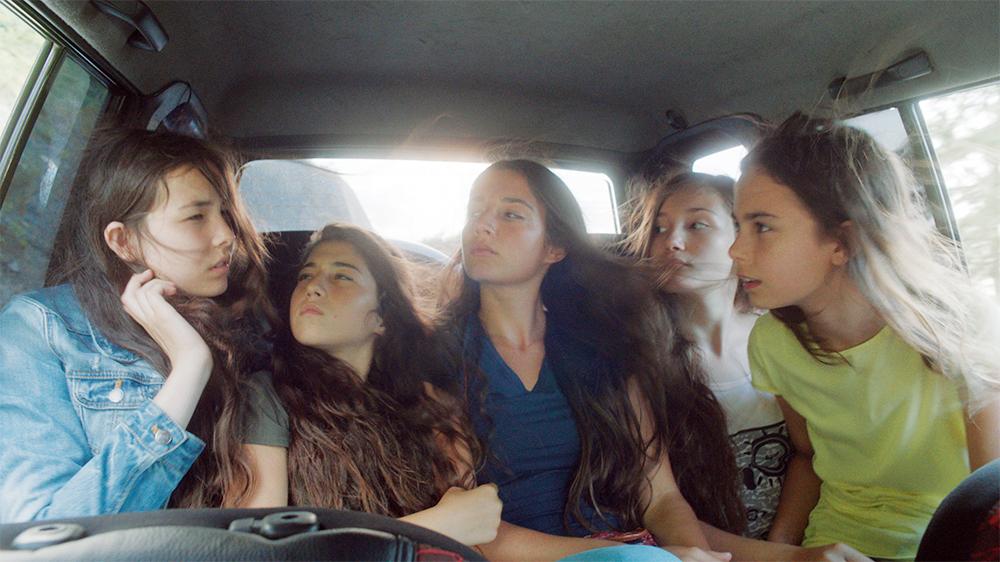
29th: Mustang – Deniz Gamze Ergüven (2015)
A stunning movie. I can’t believe how rapidly its tone shifts. Despite the circumstances, this movie starts out as being fairly light-hearted. That the 2nd half becomes as tense as any movie I’ve seen is an amazing achievement. Remarkably, none of this feels disjointed or out of place. Ergüven uses these lighter moments to attach us to the characters and set up the stakes of the film. We watch as basic freedoms are slowly taken away from them. By the time things really go dark, it feels natural. Overall, I’m blown away by the perfromances and the writing. I’ve already had to go back and watch a couple of sequences a 2nd time to understand how Ergüven pulls it off.
Grade: A
Mustang – Deniz Gamze Ergüven (2015)
30th: Kajillionaire – Miranda July (2020)
This may be the strangest film I’ve seen in some time. While I liked it, I don’t know if I ever got a handle on just what was happening. It almost reminds me of a David Lynch film in that way. It feels at times like July is communicating on her own wavelength. I can’t say this film emotionally hit me the way I was hoping. Still, I thought it was well done. July is as unique and exciting a filmmaker as there is. There aren’t many other directors who can make films like nothing you’ve ever seen before.
Grade: B-
Kajillionaire – Miranda July (2020)
Shorts
That One Day – Crystal Moselle (2016)
Toby Dammit (segment of Spirits of the Dead) – Federico Fellini (1968)
Les 3 Boutons – Agnès Varda (2015)
Ô saisons, ô châteaux – Agnès Varda (1958)
Du côté de la côte – Agnès Varda (1958)
Les fiancés of the Bridge Mac Donald – Agnès Varda (1961)

 Sam Writes Shit
2 thoughts on “2021 Movie Log: March”