

1st: The Suitor – Pierre Etaix (1962)
It’s so funny! I was cackling at parts. My two favorite bits actually happen back to back. It’s when he descends the staircase and the comes back up following the woman to see she has a partner and he turns back around. The next scene is him approaching a woman in a car to reveal that it’s a dog. I should also add I found the background bits and characters so funny. Especially the father.
I really loved following him. I found something so delightful in watching him. The way he moves was just really silly and endearing to me. I thought his face was so peaceful too. Like he’s always lost in a dream.
I noticed that the movie was broken into three bits more or less. The first 30 minutes is the introduction and his attempts to meet women in the city. The second 25 minutes is his encounter with the woman he’s trying to get away from, and the final 30 minutes is his obsession with Stella.
I saw a thematic arc being something like this:
-He’s a bookish, recluse. Seems lost in his own dreams. He’s literally closing himself off from the world with his earplugs.
-He enters the “real world” to find a wife. Has a series of failures. He finds a woman but is repelled by her.
-He sees Stella. Someone who represents the thing he’s seeking but fits into his dream world. He pursues her until she’s no longer part of this fantasy/dream idea.
2nd: Modern Times – Charlie Chaplin (1936)
Modern Times started shakily for me. I thought the scale and sheer production of the factory was incredible. The gag of him having a nervous breakdown was funny until he started chasing the woman around because her dress had buttons that matched the bolts. Just an outdated joke. After that, this movie blew me away. I found every gag delightfully funny. More than anything, the storyline carried this one for me. I was kind of shocked at just how much social commentary and anti-capitalism messaging there was. Just beautiful. The Gamin character was also wonderful. I loved how much agency she had in the story. My favorite version of Charlie Chaplin is when he is playing up his boyish side. I was really charmed by how the Gamin kind of led him through the story. I hate to focus on her appearance, but I was pretty blown away by her presence. It was hard for me not to be swept up in their love story. She was so beautiful and charismatic. I just found it to be really touching.
5th: City Lights – Charlie Chaplin (1931)
I definitely liked Modern Times more. It felt tighter and more compact. I thought the gags were more seamlessly woven into the story in Modern Times. Still, there were some real highlights for me in City Lights. I think the whistle at the party is great. It reminded me of The Suitor gag. There are so many stages that build. First, the Tramp mistakes the dessert for the man’s head. Then he takes the whistle. Then swallows it and can’t stop whistling while the musicians attempt to play. When he goes outside, the whistle hails a cab, then stray dogs, and finally, the dogs come in a crash the musicians. I just think I would have stopped at so many stages if I attempted to write a bit like that. I also have to say, I think the boxing match is my favorite Chaplin bit I’ve watched so far. It’s mesmerizing.
6th: Safety Last! – Harold Lloyd (1923)
Lloyd seemed less dynamic as a character than the other silent stars I’ve watched (Tati, Chaplin, Etaix). The description on Criterion describes him as an everyman which I think seems right. I loved the score for this one. It seemed to be more a part of the film than in other ones I’ve watched. I also loved how he kept looping themes and plot lines back in. It struck me as a pretty modern. At the beginning, he’s late for work and adjusts the hands on the clock. By the end, he’s hanging from the hands of a clock tower. Likewise, I think the gag of him mixing up the cops and having his roomie shove the wrong one was extremely silly. But it was cool that he uses it as a device to have the cop chase the roomie away while he attempts to make the climb.
7th: Fry Day (short) – Laura Moss (2017)
Watched at Beronica’s with her and Wills. I really liked it. It’s unique and unsettling. The protagonist especially is captivating. I’d definitely be into checking out anything else Moss does.
7th: Dance, Girl, Dance – Dorothy Arzner (1940)
Watched at Beronica’s with her and Wills! Hopefully the start of a super cool movie club. It was a fun movie. Super melodramatic. Pretty overstated and soapy. It reminded me in some ways of Valley of the Dolls or Mildred Pierce in the scope of what is happening. So much of the movie is over the top. I’m curious as to why this film is considered a masterpiece. Don’t get me wrong, I dug it and had a fun time watching it. But a lot of that was due to its melodrama, not the story. It seems like a big reason for its legacy is that it subverts some masculine framing and ideology. I can for sure see that point in Judy’s speech at the end. However, the portrayal of Bubbles feels out of date. But who knows. Maybe it was progressive to even have a character like her in 1940?
Dance Girl Dance – Dorothy Arzner (1940)
9th: Babette’s Feast – Gabriel Axel (1987)
Watched at home with Gioia. Perhaps the most wholesome movie I’ve ever seen. It was so heartfelt and delightful. A type of movie that I’ve really never watched before. It’s definitely a slow burn. But once the plot starts moving, it really is so charming. I wish I had more to say on it. Truthfully, I’m not even sure I can say why I liked it so much. For such a simple premise, there is a kind of mysterious power to it.
Grade: A
Babette’s Feast – Gabriel Axel (1987)
9th: Before Midnight – Richard Linklater (2013)
I shudder to think how many entries I’ve already made for this movie. What else to say? It may be my favorite of the series. The first two movies reflect some experiences I’ve had. Falling in love, making a connection. They feel like the fairytales of realism. They highlight the best, most important moments of life. They capture a certain kind of power which is those magical nights that do really happen. Before Midnight may be a more impressive accomplishment. I haven’t had kids or broken marriages. Yet, I understand their arguments. They move in the way real fights do. The characters start with one thing and dance around the issues until they can bring it into the open. You relate to both of them, understand their differences, and yearn for them to keep their connection. This one, again, is steeped in realism but it’s not a fairytale. The ending is incredible. I think I’ll always be moved by it. It’s these two characters stranded and still reaching out to each other. Wouldn’t you know it, I’ve written another long entry about this one. Whoops 🙂
Grade: A
10th: Scary Stories to Tell in the Dark – André Øvredal (2019)
Watched at the Regal City on Western with Wills, Beronica, Beronica’s brother, and Hannah. It’s fun and stupid, but not good. I think the most disappointing thing, is that it seems like it could have been good. I liked the premise of the movie. It was a smart way to incorporate this pre-existing IP into a new story. Likewise, some of the scares were genuinely good. Particularly the scarecrow and the pimple. What I think was lacking in the movie, was any real commitment to flesh out the story. It’s hinted at a couple of times that the stories have particular meaning for the people. The jock really hating the scarecrow for instance. Or that the one friend could feel neglected by his family, making the toe scarier. Instead, none of it is developed. They just go straight into the scares. The fact that there were so many unanswered plot lines just because there will be a sequel is so bad. It’s bad movie-making. What can you do? I still had fun.
Grade: D
Scary Stories to Tell in the Dark – André Øvredal (2019)
13th: Baby Face – Alfred E. Green (1933)
Watched at home. Before this film, I didn’t know about Pre-Code Hollywood. It was apparently a brief era between the silent era and 1934 in which there wasn’t much censorship. That would add up. The storyline of Baby Face was surprisingly edgy. I think in some ways, it’s doing what The Love Witch was going for. Turning preconceived notions of gender roles and sexuality on the story to make a point. Here though, these messages are fully engrained in the story. It doesn’t feel like watching a meta-commentary on societal structures. It feels like watching a movie. I really enjoyed watching it. I especially dug that it was like 75 minutes. I’m still wary of the melodrama of most of these 30s and 40s films. I think it’s engrained in the era, but isn’t my favorite type of storytelling.
Grade: B
Baby Face – Alfred E Green (1933)
14th: Howl’s Moving Castle – Hayao Miyazaki (2004)
Watched at home with Gioia. This was my first Miyazaki / Studio Ghibli film. It was delightful! Based on my own silly assumptions, I expected it to be weightier. I was afraid that with the reverence people have for these movies, its messages would be telegraphed on to it. Instead, I found this film to be so lighthearted, spontaneous and joyous. It felt completely free of any messaging. That’s not to say that the film doesn’t touch on weighty themes or isn’t worth critical thought. It absolutely is. But I really loved how the characters moved through life and the story without a lot of external motives. For instance, there wasn’t any heartfelt moment of pain when Sophie is transformed into an old woman. Instead, she just goes out to solve the problem. We know that she wants to be changed back and the movie doesn’t try to explain that she would. It’s intuitive. My favorite parts of the movie were its eccentricities. They were so surprising and fun. If I had a critique, it would be that the logic of the story isn’t airtight. I didn’t understand a ton of the plot. In this type of movie though, it really didn’t matter. I was having too much fun with the peripheral details to care.
Grade: B+
Howl’s Moving Castle – Hayao Miyazaki (2004)
17th: Blinded by the Light – Gurinder Chada (2019)
Watched at the Nickelodeon with Gioia, my dad, Barbara, Sophia, and Tom. I don’t know where to begin. Bruce Springsteen is obviously an enormous figure to me. To watch a film try to present and unpack a fan’s relationship with his music is one thing. To try to think about it objectively is another. Overall, I really liked it. I recognized and understood all the reasons that Javed felt such devotion to Bruce and his music. I honestly just liked hearing Springsteen played super loud in a movie theater. I thought the move smartly poked fun at Javed and his devotion. I think it also recognized that this type of relationship can happen between anything. It’s essentially the magic of life to find something that speaks so deeply to you. The film was extraordinarily earnest and that really worked for it. I think the ending is deeply emotional. That tone also means that so much of the film borders right on the edge of embarrassment. As much as I love Thunder Road, Badlands, and Born to Run, it’s hard to watch a teenager sing it so earnestly to the people he loves. I don’t know what else to say. Bruce is the best, and I’m glad this movie was so good.
Grade: B / B+
Blinded by the Light – Gurinder Chada (2019)
22nd: Akira Kurosawa’s Dreams – Akira Kurosawa (1990)
Watched at work. It is really, really slow-moving. I was kind of amazed at how slowly Kurosawa develops some scenes. Specifically, the Mountain / Blizzard one. It pushed me to try and not look at my phone during it. But, it seems like this slowness is very much the point. Many of the dreams are about the downfalls of technological advancement. In the last dream, that point is stated explicitly. I think the pace is a challenge to hold our attention and find the beauty in it. The simple pleasures as it were. I noticed a lot of the scenes provided a moment of catharsis for its characters. Moments that in real life could never happen. I’m thinking specifically of the boy getting to scream and cry about the Peach Blossoms or the soldier confessing his guilt at the dead platoon. I liked it. The film starts with a somber wedding (for foxes!) and ends with a joyous funeral (for a woman :/). Thought those were cool bookends to the film. I don’t think I’ll ever watch this again. It really was a slog at times to get through it. There is certainly a lot of depth to it, but maybe not enough for me to revisit it.
Grade: C+ / B-
22nd: Performance – Donald Cammell and Nicolas Roeg (1970)
Watched at home. It’s exhilarating. The way it is shot and edited seems exceedingly modern. It reminded me of films by Tarantino, Fincher, and Soderbergh. Those films obviously all come 20 years after this. I honestly couldn’t understand about half of the dialogue and am not sure it truly mattered. So much of this movie is a vibe. I think you could definitely go through the script and find a constructed crime film in there, but the real highlights for me were the fast cuts, strange edits, and wild energy spilling out of the film. Also, Mick Jagger is phenomenal.
Grade: B+ / A-
Performance – Donald Cammell and Nicolas Roeg (1970)
25th: Harold and Maude – Hal Ashby (1971)
Watched at home. It’s delightful. It’s so funny, odd, and heartfelt. The movie was actually pretty straightforward, but it felt so bizarre due to all its eccentricities. On top of that, everything in the film is brilliantly structured. The film opens with Harold faking suicide and ends with him deciding against it. I loved that there’s never any scene in which Harold and Maude’s relationship is judged. The closest we come is Harold’s mother’s reaction. Even then, Maude isn’t there. It’s so positive and humanistic, even in the face of so much death and gloom. The musical cues work really well down to Harold picking up the banjo and strumming Cat Stevens. A total classic.
Grade: A-
Harold and Maude – Hal Ashby (1971)
25th: First Man – Damien Chazelle (2018)
It now makes sense to me that this film didn’t receive any accolades. It’s slow, methodical, and (pardon the pun) grounded. That doesn’t make the lack of awards right. This film is masterful. I really think Chazelle is one of the best filmmakers working right now. His approach here is to focus on the tiny, human details of this mission. There are no grand flourishes, no overtures. There’s not a triumph in beating the Soviets to space. Instead, there’s a reflection on the price to pay for it. He focuses on the silences, on the literal nuts and bolts holding the ship together. Armstrong isn’t a patriotic hero. He’s a quiet genius. Buzz Aldrin isn’t an infallible 2nd in command. He’s a wise-cracking cynic. It makes sense that this film wasn’t a hit. It’s a methodical examination on how we got to the moon. It’s a quiet triumph.
Grade: B+ / A-
First Man – Damien Chazelle (2018)
27th: Christopher Strong – Dorothy Arzner (1933)
Watched at work. In a lot of 30s and 40s films, I struggle with their melodramatic tone. It’s just something that hasn’t clicked for me. I feel that it usually takes away from the story. What’s the worst thing that could happen? It happens. Christopher Strong definitely has melodrama in it. But it totally works for me. I think perhaps because so much of it is re-directed or subverted. There’s a scene in which Monica leaves the party with a random dude who talks about how much he’s been drinking. In any other movie, I think she dies in a car crash. Here there is a major consequence, but it’s that her boyfriend leaves her because she confesses to sleeping with this man. Likewise, I think other movies begin the affair at the end of Act 1. Here, the main tension isn’t the affair, but whether or not the two characters can hold out before engaging in it. It was brilliant.
Christopher Strong – Dorothy Arzner (1933)
27th: Spirited Away – Hayao Miyazaki (2002)
Watched at home with Gioia. I felt like I’d have some idea of this movie going into it. It’s so renowned. I’ve seen probably a dozen stills from it. There is so much No-Face merch in the world. Plus, I had seen Howl’s Moving Castle earlier and thought I’d have a grasp on these movies. I was wrong. It was so surprising. My biggest misconception was not realizing how understated this movie would be. Of course, there are spirits, talking animals, witches, and so much magic. All of these just move you through the story. They aren’t disruptive. Amidst all of this, Chihiro goes through an incredible personal transformation and it’s never explicitly commented on. It’s the whole emotional force of the film and it is seamlessly interwoven into the story. My favorite decision in Howl’s Moving Castle was that Sophie never laments her curse or has a dramatic moment to ruminate on it. It’s the same here. We see that Chihiro is ignored by her parents and is underestimated and condescended to by everyone at the spa. But it’s never reflected on. There is no moment for her to cry out about these injustices. At the end, when she has finally earned respect and friendship, she has to leave the spa to go back to her parents. Finally, there will be the moment where Chihiro reflects and laments how life always pushes forward and leaves everything behind. And then there’s a literal rule that she can’t look back or the magic won’t work. It’s so brilliant and true to life. Most importantly, it’s so much more heartfelt than in every other movie in which there’d be an engineered bullshit moment where she looks back at the spa and all her friends.
Grade: A
Spirited Away – Hayao Miyazaki (2002)
28th: Gone Girl – David Fincher (2014)
Watched at home. The first 2/3rds of the film are perfect. Totally mesmerizing, meticulously executed. It’s impeccably crafted. Every moment of the film can be read multiple ways. The film leads you down avenues even while you’re wary of making conclusions. I especially liked as Nick and Amy’s stories started to diverge. You realized that this isn’t a film with one perspective or truth. And this idea is what the film is centered on. The idea that you never truly know anyone else’s point of view. The twist in the middle is an all-timer. I had even suspected that’s where it was going having waited a few years to see the movie, and it was still stunning. It’s a perfect moment not just because of everything that builds up to it, but because of the execution there. Amy’s monologue is so smart and cutting. Even though she is a psychopath, you completely understand her motive. I do think the movie falters once Amy loses control. Fincher is trying to do something more ambitious and interesting than resolving a traditional mystery. Here, he wants to incorporate aspects of satire and social commentary. Most of which work. Still, I find that this part of the film doesn’t add up to the thrill of the first two hours when Nick (and the viewer) is in Amy’s web. The exception is the murder of Desi which is shocking and grotesque. To me, this is certainly Fincher’s third-best movie. I would still put it a good distance behind Zodiac and The Social Network. While it’s not a masterpiece, it’s arguably his most ambitious movie and has many aspects that are perfect.
Grade: B+ / A-
Gone Girl – David Fincher (2014)
29th: Matador – Pedro Almodóvar (1986)
Watched at home with Gioia. It’s really something else. Almodóvar is so stylistically assured. He hits you with his vision immediately. Sex and violence are interwoven so they don’t make complete sense. From there, we move into our story. It’s a fairly tight story. Ángel turns himself in for these murders in an attempt to prove his manhood. There, his visions lead everybody to the two murderers: his teacher and his lawyer, who are almost star-crossed sexual deviants. Throughout it, he uses the metaphor of bullfighting and interwoven into the story are themes of emasculation, toxic masculinity, and sexuality. The aspects of the story that are hard to believe (which are many) are almost completely covered by camp, humor, and stylistic flourishes. Overall, I was really impressed. I think it’s incredibly impressive on paper. There are some moments that are a tad slow or too telegraphed to be truly surprising. My guess is that Almodóvar tightens these aspects up in his future films.
Grade: B
Matador – Pedro Almodóvar (1986)
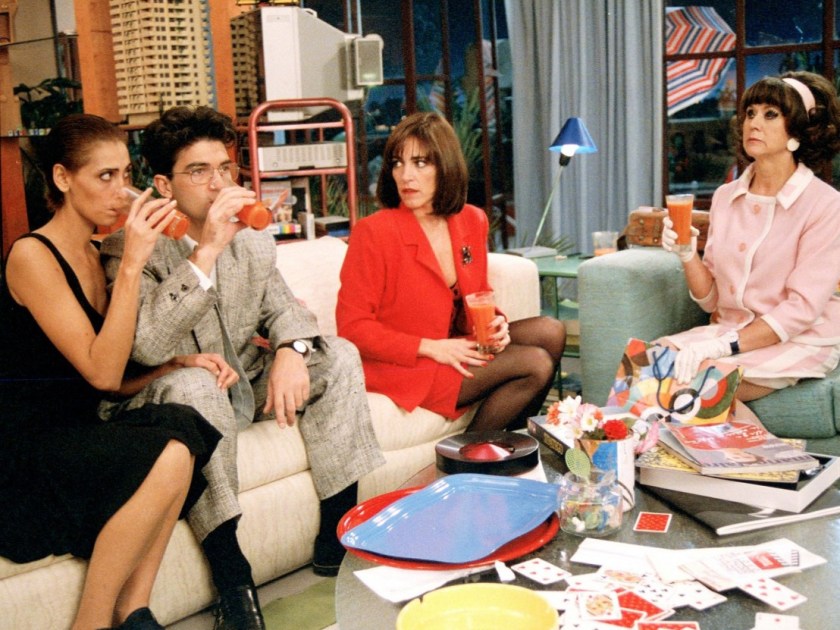
30th: Women on the Verge of a Nervous Breakdown – Pedro Almodóvar (1988)
Watched at home with Gioia. It’s insane how much tighter Almodóvar becomes in just two years. While I really liked Matador there were definitely slower parts. Its mastery was in the way the whole story unfolded. Still, some of its scenes were lacking. Every detail in Women… feels meticulously reworked to perfection. As with Matador, the sets and costumes here are all bright and beautiful. The performances are tremendous. Every detail that comes up in the film reappears at the precise right moment. It’s a movie made out of setups and payoffs. The working of the plot feels like something out of Oscar Wilde. It is remarkable. I’m sad I didn’t catch more of Almodóvar’s movies when they were on the Criterion Channel. He seems like one of the greats.
Grade: A
Women on the Verge of a Nervous Breakdown – Pedro Almodóvar (1988)
31st: The Farewell – Lulu Wang (2019)
Watched at the Logan with Gioia. I liked it. The performances were really powerful. The set up of the family was incredibly well thought out. Without too much exposition, you felt like you knew how each family member fit in and their relationship to this decision. I also really liked seeing a movie set in China. I thought it was fascinating to navigate the city and family with Billi. My big critique is this: I felt they really stretched this central tension as far as it could go. It seemed every scene was someone debating whether or not they would tell Nai Nai she was dying. Gioia made the point that it’s probably true to life. Anytime a family or a friend group has a secret, it tends to be the only thing people talked about. Still, the movie hinted at other tensions I would have loved to see explored. The pull Billi feels between the two countries. The toll following your own pursuits costs: in this case leaving your family. I felt this movie took about a 75-minute story and stretched it to 90 minutes. What I would have been more interested in, ironically, is seeing this story really expand. What’s the 135-minute version of this film? Still, the ending was incredibly moving. I was so thankful they never had a scene in which Nai Nai and Billi confront each other over this secret. I am convinced that Nai Nai knew about the secret even though it’s never shown or commented in the movie. That’s good filmmaking.
Grade: B / B+
The Farewell – Lulu Wang (2019)

 Sam Writes Shit
2 thoughts on “2019 Movie Log: August”